O-1871 ATC code Legal status
Banned as cyclohexylphenol derivative (US, UK)
2-(3,3-dimethylcyclohexyl)-5-(2-methyloctan-2-yl)benzene-1,3-diol
CAS Number PubChem CID ChemSpider UNII CompTox Dashboard (EPA ) Formula C 23 H 38 O 2 Molar mass 346.555 g·mol−1 3D model (JSmol)
CC(C1)(C)CCCC1C2=C(O)C=C(C(C)(C)CCCCCC)C=C2O
InChI=1S/C23H38O2/c1-6-7-8-9-13-23(4,5)18-14-19(24)21(20(25)15-18)17-11-10-12-22(2,3)16-17/h14-15,17,24-25H,6-13,16H2,1-5H3
Key:WBSPBIRKSHKQQD-UHFFFAOYSA-N
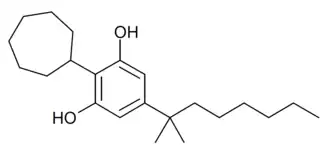
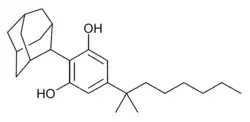
O-1871 is a potent cannabinoid agonist which was invented by Billy R Martin and Raj K Razdan at Organix Inc in 2002. It has a CB1 receptor affinity of 2.0 nM and a CB2 receptor affinity of 0.3 nM.[ 1] CP 47,497 ,[ 2] O-1656 and the 2-adamantyl derivative O-1660, as well as the corresponding 3,5-dichlorophenyl derivative,[ 3]
O-1656, CAS# 468083-75-2 [1]
O-1660, [2]
See also
References
^ WO application 03091189 , Martin BR, Razdan RK, "Cannabinoids", published 6 November 2003, assigned to University of Virginia ^ Debruyne D, Le Boisselier R (2015). "Emerging drugs of abuse: current perspectives on synthetic cannabinoids" . Substance Abuse and Rehabilitation . 6 : 113– 29. doi:10.2147/SAR.S73586 4622447 26543389 . ^ US application 2004087590 , Lai XZ, Lu D, Makriyannis A, "Novel biphenyl and biphenyl-like cannabinoids", published 6 May 2004, assigned to University of Connecticut
Phytocannabinoids
Cannabibutols Cannabichromenes Cannabicyclols Cannabidiols Cannabielsoins Cannabigerols Cannabiphorols Cannabinols
CBN
CBNA
CBN-C1
CBN-C2
CBN-C4
CBNM CBND
CBNP
CBVD
Cannabitriols Cannabivarins Delta-3-tetrahydrocannabinols Delta-4-tetrahydrocannabinols Delta-7-tetrahydrocannabinols Delta-8-tetrahydrocannabinols Delta-9-tetrahydrocannabinols Delta-10-Tetrahydrocannabinols Delta-11-Tetrahydrocannabinols Miscellaneous cannabinoids Active metabolites
Endocannabinoids Synthetic
Classical cannabinoids Non-classical Adamantoylindoles Benzimidazoles Benzoylindoles
1-Butyl-3-(2-methoxybenzoyl)indole
1-Butyl-3-(4-methoxybenzoyl)indole
1-Pentyl-3-(2-methoxybenzoyl)indole
AM-630
AM-679
AM-694
AM-1241
AM-2233 GW-405,833 (L-768,242)
Pravadoline RCS-4 WIN 54,461 Cyclohexylphenols Eicosanoids
AM-883 AM-1346
ACEA
ACPA
Methanandamide (AM-356)
O-585
O-689
O-1812 O-1860
O-1861 Indazole-3- Indole-3-carboxamides Indole-3-carboxylates Naphthoylindazoles Naphthoylindoles Naphthoylpyrroles
JWH-030 JWH-031
JWH-032
JWH-033
JWH-036
JWH-044
JWH-045
JWH-145 JWH-146 JWH-147 JWH-150 JWH-156
JWH-243
JWH-244
JWH-245
JWH-246
JWH-292
JWH-293
JWH-307 JWH-308
JWH-309
JWH-346
JWH-347
JWH-348
JWH-363
JWH-364
JWH-365
JWH-366
JWH-367
JWH-368
JWH-369
JWH-370
JWH-371
JWH-372
JWH-373 Naphthylmethylindenes Naphthylmethylindoles
JWH-175 JWH-184
JWH-185
JWH-192
JWH-194
JWH-195
JWH-196
JWH-197
JWH-199 Phenylacetylindoles Pyrazolecarboxamides Tetramethylcyclo- Tetramethylcyclo- Others
Allosteric CBR Tooltip Cannabinoid receptor ligandsEndocannabinoid (inactivation inhibitors) Anticannabinoids (antagonists/inverse