6

I have a 40' section of RG-8 that is about 35 years old. One end was terminated with a standard PL-259 and the other was soldered directly to an antenna.

When I removed the connector from the one end, the cable itself appeared pristine. The other end needed a few inches removed but also appeared pristine when the obviously weathered part was removed.

Is there any reason not to reuse this cable? I'll be using it on a dual band, 2m/440 ground plane.

Edited to add: This cable has been indoors for most of its life.

Lance
  • 941
  • 1
  • 8
  • 23

3 Answers3

3

Yes.

Left alone in a warehouse, undisturbed, it probably degrades in some fashion, though any time I have ever seen a find like that there is usually a feeding frenzy as people take it in part or in whole for use. So I don't have any personal knowledge about that kind of degredation.

In your Q, you hit the nail on the head. Often the coax will be fine and the connectors are of the most concern, usually due to water intrusion.

But consider the effects of the elements to the coax, particularly sun exposure. Any coax exposed to the elements will definitely degrade over time due to heat cycling and perhaps mechanical wear.

Typically the outer cladding is likely to become brittle and thus be more likely to crack if you bend it. Then water intrusion will cause eventual degradation of the shield.

To the point of your question, RG-8 is pretty rugged, and if it is still working after 35 years I can't think of any reason not to repurpose it. I would definitely suggest cutting the ends and installing new connectors.

Particularly with THAT Antenna. When I saw the first pictures of it, the end that was soldered to the antenna was definitely weathered. My very first thought was that the antenna end needed to be reterminated. And weather sealed.

But I didn't notice any problems with the cable away from that end.

SDsolar
  • 2,107
  • 1
  • 17
  • 36
1

With old coax the things you're most likely to see are UV degradation of the insulation and water ingress.

Visually inspect the insulation, looking for cracks when bent. If this cable was not exposed to the sun, it's probably fine in this regard.

Water ingress will show as corrosion on the conductors, an increase in loss, or a change in characteristic impedance. The ends are most susceptible, so remove them if the shield appears corroded. For the outdoor end you might consider removing a couple feet more to be safe. There may also be nicks or fine cracks in the insulation that allowed water to enter which you may not be able to see.

Put a dummy load on the far end of the cable, and check with an antenna analyzer. The SWR should be flat over the entire range of the analyzer. If you don't have an analyzer, a directional coupler in conjunction with a signal generator or low power transmitter works also.

To check for loss, you can make a simple RF detector to measure the peak voltage:
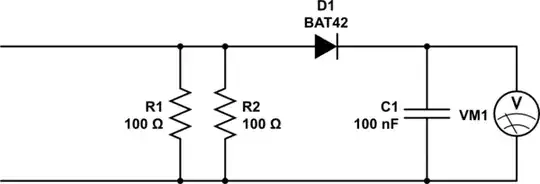
schematic

simulate this circuit – Schematic created using CircuitLab

Use a Schottky diode for best sensitivity, though an ordinary silicon diode like 1N4148 may work well enough. Keep the leads between the resistors, diode, and capacitor as short as possible. The voltmeter can have long leads since it's measuring DC. Ordinary 1/4W resistors are fine as long as testing is limited to low-ish powers (<10W) and brief (a couple seconds) periods.

I build it into a BNC connector. This one worked fine at 440 MHz:
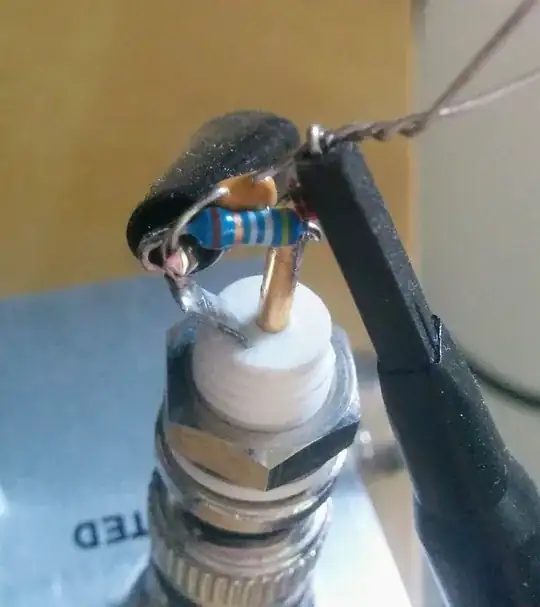
enter image description here

Measure the power directly from your antenna analyzer / signal generator / low power transmitter. Then put it on the end of the coax, and measure that. Power is proportional to the square of voltage.

$$ \text{loss (dB)} = 20 \log_{10} \left(V_\text{in} \over V_\text{out}\right) $$

If the cable passes visual inspection, SWR test, and loss test, it's fine to be reused. And you'll also know the loss, so you can decide if it's worth getting some better coax.

Phil Frost - W8II
  • 52,635
  • 8
  • 91
  • 225
1

Cables come in different classes. I do not remember the details, but there is for example RG8/U, RG8A/U, RG8B/U, RG223 and probably more. All those are pretty equivalent, but some have a short life time because the cheap PVC outside the screen will migrate into the polyethylene dielectric and cause (severely) increased losses. Read here: http://www.smeter.net/daily-facts/4/fact29.php

A cable with a polyethylene jacket is safe for ageing, but less so for fire. I think you can find specifications for the lifetime of different cable types if you look carefully at manufacturer data.

sm5bsz
  • 1,019
  • 5
  • 3