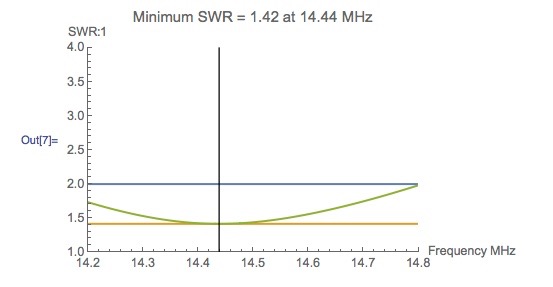
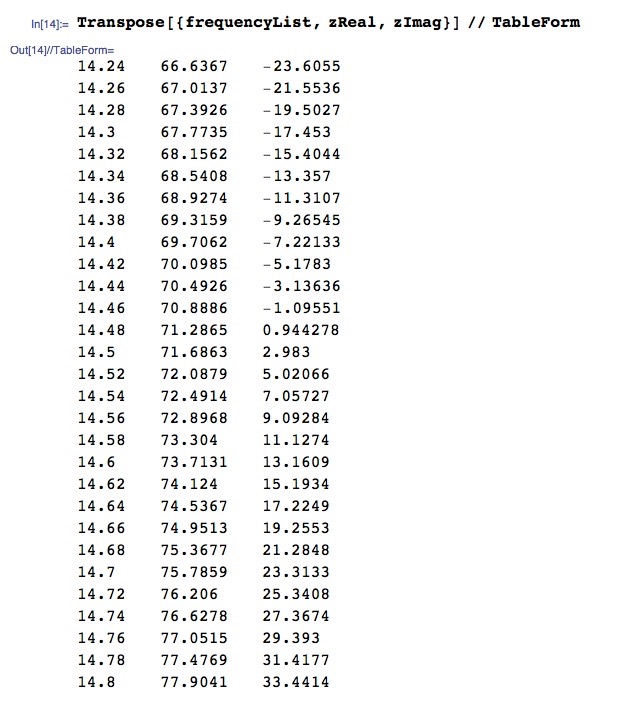
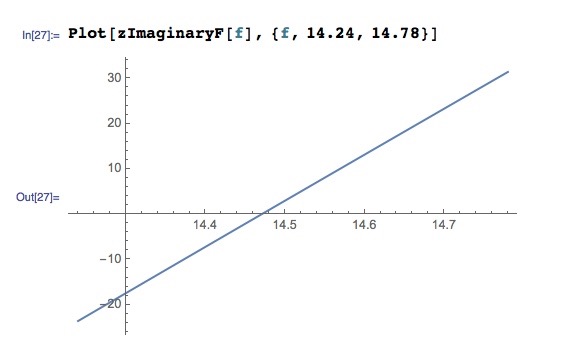
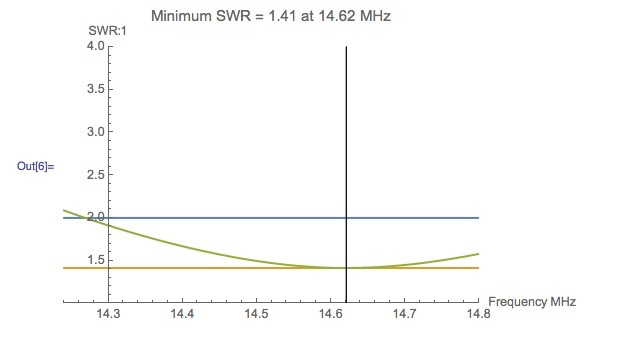
Assuming the antenna is in free space, you only need to know the length and diameter of the wire used to construct the dipole. The math is hairy but I wrote a program to do the calculations. Here is the SWR (assuming a 50 ohm source) and feedpoint impedance for a dipole 10 meters long, with a diameter of 2.053mm:
14.100 MHz: SWR 2.07,  61.3 + j-39.6
14.130 MHz: SWR 1.98,  61.7 + j-36.8
14.160 MHz: SWR 1.89,  62.0 + j-34.0
14.190 MHz: SWR 1.81,  62.4 + j-31.3
14.220 MHz: SWR 1.73,  62.8 + j-28.5
14.250 MHz: SWR 1.66,  63.2 + j-25.7
14.280 MHz: SWR 1.60,  63.5 + j-23.0
14.310 MHz: SWR 1.54,  63.9 + j-20.2
14.340 MHz: SWR 1.48,  64.3 + j-17.4
14.370 MHz: SWR 1.44,  64.7 + j-14.7
14.400 MHz: SWR 1.40,  65.1 + j-11.9
14.430 MHz: SWR 1.37,  65.5 + j-9.1
14.460 MHz: SWR 1.35,  65.8 + j-6.4
14.490 MHz: SWR 1.33,  66.2 + j-3.6
14.520 MHz: SWR 1.33,  66.6 + j-0.9
14.550 MHz: SWR 1.34,  67.0 + j 1.9
14.580 MHz: SWR 1.36,  67.4 + j 4.7
14.610 MHz: SWR 1.39,  67.8 + j 7.4
14.640 MHz: SWR 1.43,  68.2 + j10.2
14.670 MHz: SWR 1.47,  68.6 + j13.0
14.700 MHz: SWR 1.52,  69.0 + j15.7
14.730 MHz: SWR 1.57,  69.4 + j18.5
14.760 MHz: SWR 1.63,  69.9 + j21.3
14.790 MHz: SWR 1.69,  70.3 + j24.1
14.820 MHz: SWR 1.75,  70.7 + j26.8
14.850 MHz: SWR 1.82,  71.1 + j29.6
14.880 MHz: SWR 1.89,  71.5 + j32.4
14.910 MHz: SWR 1.97,  71.9 + j35.1
14.940 MHz: SWR 2.05,  72.4 + j37.9
To calculate the bandwidth we must define what we mean by bandwidth. Let's define it as the range through which SWR is 2:1 or less. In that case, this antenna works from about 14.125 to 14.920 MHz, for a bandwidth of 795 kHz.
We can express that as a fractional bandwidth:
$$
{14.125 - 14.920 \over (14.125 + 14.920) / 2} = 5.5\%
$$
You'll find that similar dipoles will have a similar fractional bandwidth. For example if I run the numbers for the same wire diameter but now 20 meters long, I find a fractional bandwidth of 5.0%.
This decrease in bandwidth is due to the wire diameter being thinner relative to wavelength. A thicker dipole relative to wavelength will have more bandwidth than a thinner one. The bandwidth is actually quite sensitive to the conductor radius.*
For example, if I make a dipole for the 2 meter band from 3/4 copper pipe, the fractional bandwidth goes up to 15% on account of the much smaller wavelength and the much thicker wire.
If you need just a rough calculation, then an estimate of fractional bandwidth is sufficient. Just multiply the center frequency by the fractional bandwidth.
Here's the source for the program, if you want to do your own calculations:
#!/usr/bin/python3

from math import sin, cos, log
from scipy.special import sici
from scipy.constants import pi, c

def sin2(t):
    return sin(t)**2

def ci(t):
    '''cosine integral'''
    return sici(t)[1]

def si(t):
    '''sine integral'''
    return sici(t)[0]

# euler constant
gamma = 0.577215664901532

# impedance of free space
Z0 = 376.73031

def R(f, L, a):
    k = 2*pi*f/c

    return Z0 / (2*pi*sin2(k*L/2)) * (
        gamma
        + log(k*L)
        - ci(k*L)
        + .5 * sin(k*L) * (
            si(2*k*L)
            -2*si(k*L)
        )
        + .5 * cos(k*L) * (
            gamma
            + log(k*L/2)
            + ci(2*k*L)
            - 2*ci(k*L)
        )
    )


def X(f, L, a):
    k = 2*pi*f/c

    return Z0 / (4*pi*sin2(k*L/2)) * (
        2*si(k*L)
        + cos(k*L) * (
            2*si(k*L)
            - si(2*k*L)
        )
        -sin(k*L) * (
            2*ci(k*L)
            - ci(2*k*L)
            - ci(2*k*a**2/L)
        )
    )


def Z(f, L, a):
    return complex(R(f, L, a), X(f, L, a))


def SWR(Z_l, Z_s):
    reflection_coef = (Z_l - Z_s) / (Z_l + Z_s)
    return (1 + abs(reflection_coef)) / (1 - abs(reflection_coef))


# in Hz
f_lower = 137e6
f_upper = 155e6
step = 750e3

# in meters
length = 0.942
diameter = 19.05e-3

# in ohms
source = complex(50)

f = f_lower
while f < f_upper:
    load = Z(f, length, diameter)
    print('    %6.3f MHz: SWR %4.2f, %5.1f + j%4.1f' % (f/1e6, SWR(load, source), load.real, load.imag))
    f += step
* Note how $a$ appears only in the $\mathrm{Ci}(2ka^2/L)$ term, and the cosine integral function asymptotically approaches $-\infty$ at 0.