If you want a closed-form function, Wikipedia gives those:
\begin{align}
R &= \frac{Z_m}{2 \pi \sin^2(kL/2)} \Big\{
\gamma + \ln(kL) - \operatorname{Ci}(kL) + \tfrac{1}{2}\sin(kL) \big[\operatorname{Si}(2kL)- 2\operatorname{Si}(kL)\big] \\
&\qquad\qquad\qquad\qquad + \tfrac{1}{2}\cos(kL)\big[ \gamma + \ln(kL/2) + \operatorname{Ci}(2kL) - 2\operatorname{Ci}(kL) \big]
\Big\} \\
X &= \frac{Z_m}{ 4 \pi \sin^2(kL/2)} \Big\{
2 \operatorname{Si}(kL) + \cos(kL)\big[ 2 \operatorname{Si}(kL) - \operatorname{Si}(2kL) \big] \\
&\qquad\qquad\qquad\qquad - \sin(kL)\big[ 2 \operatorname{Ci}(kL) - \operatorname{Ci}(2kL) - \operatorname{Ci}(2ka^2/L) \big]
\Big\}
\end{align}
I'm not even going to try to explain those equations since they are so hairy. Easier, and more insightful is to see a graph of the equations (from the same Wikipedia article):
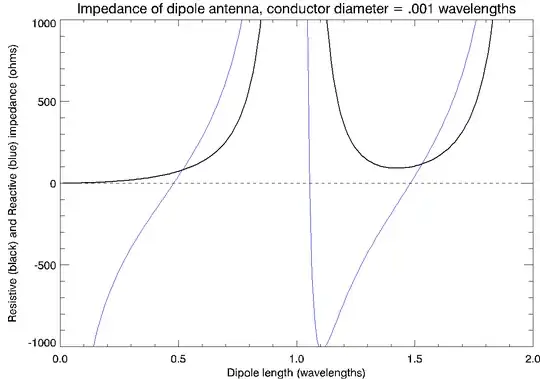
In theory, a 5/8 monopole has an impedance of something like $(75-425j)\:\Omega$, and the impedance of a dipole is twice that of the equivalent monopole, so $(150-850j)\:\Omega$. Eyeballing that on the graph looks about right.
However, the thing to note here is that around 1.25λ, the slope of both the real and imaginary components of the impedance is pretty steep, meaning small changes in length make large changes in impedance. Also note that this graph is valid only for a conductor diameter of 0.001λ. Thicker or thinner conductors can also make a significant difference. The sensitivity of the impedance to these parameters explains the variance in the numbers given by various sources.
Consequently, to successfully build this antenna you will need some way to measure the impedance and adjust accordingly.


