-3

In a youtube video titled "Antenna Engineer Vs Ham Radio Myths! True or False?" the guy says this in the comments:

The idea that a non resonant antenna cannot accept current as well as a resonant antenna is a myth. Of course you have to use a tuner with a non resonant antenna.

I highly doubt that, am I wrong to say this guy is full of it?

Marcus Müller
  • 18,064
  • 26
  • 50
K3ZD
  • 11
  • 1

2 Answers2

5

I don't know what is meant by "accept current", but a non-resonant antenna, as long as it is at least a half wavelength, will have at least one place on the antenna where current can reach its maxima. Take an end-fed 5/8 wave vertical antenna, this has a current maxima just above the middle, a 1/4 wavelength from the end of the antenna, just as a half wave antenna does, and then another current loop that doesn't reach a maxima, just above the feed-point. These two current loops combine to make the far-field have more gain at the horizon than a half-wave antenna, and I don't think you'll find anyone who would say that the total radiated power is any lower than a resonant antenna, it's simply that the energy field is shaped differently due to the number and magnitude of the current loops.

Also remember, that any antenna that isn't a perfect multiple of a 1/4 wavelength of the frequency it's being used on, is a non-resonant antenna.

The red lines below, indicate the position and magnitude of the current loops on the various antennas. The blue arrows indicate the direction of the current on the antenna. Notice that lengths beyond 1/2 wavelength, you have current flowing in different directions. This causes constructive interference in some parts of the far-field, and destructive interference in other parts of the far-field.
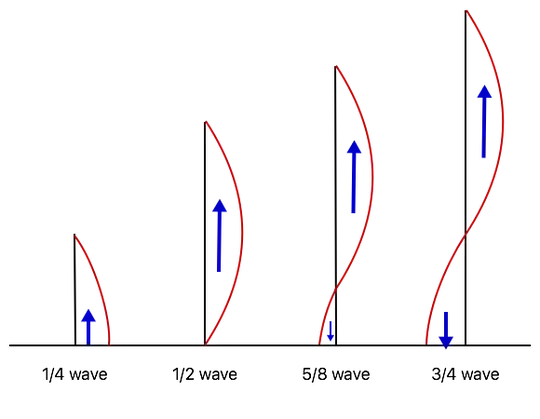
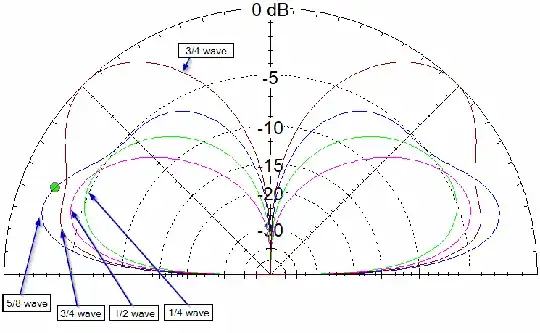
enter image description here enter image description here These far-field plots are over "real ground".

Louis Seaman
  • 1,058
  • 3
  • 10
0

The quoted statement is true. I would use words like "utilize" rather than "accept" because the latter word carries a risk of being naively construed as an impedance question (i.e., high impedance Z or low admittance Y vs low Z or high Y).

There is not much difference in how the antenna utilizes the RF current, whether the antenna is "resonant" or otherwise. The notion of "resonant" in the antenna context is poorly applied; it often means the feedpoint impedance has a near-zero imaginary component, nothing more. There is no magical difference that happens all of sudden when the element is perfectly adjusted to vanish the reactance component.

Any antenna requires a matching circuit unless the antenna happens to be matched to the feedline ("resonant" or otherwise.)

Louis Seaman's answer focused on the radiator's current distribution and the radiation pattern, the factors that relate to the antenna performance. Not shown but 3/8 wavelength is another popular choice, and the antenna performs very well regardless of the ground quality. (1/4 and 5/8 are more sensitive the the ground quality.) Both 3/8 and 5/8 are generally considered "non-resonant" antennas in the amateur terminology but they work well. (5/8 works less well when the ground is highly conductive, like very wet ground or above water.)

Ryuji AB1WX
  • 2,962
  • 1
  • 1
  • 26