2

It's a bit counter-intuitive that for an HF vertical antenna (such as a quarter wave monopole) the best advice is to put as many radials and as close to the proper length as possible.
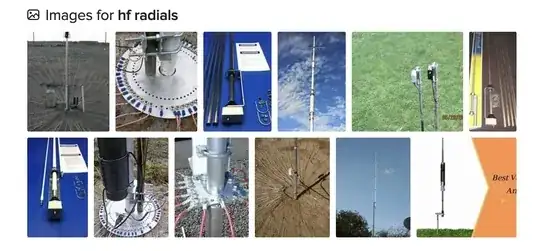
Sample image search results showing dozens of radials out across the fields around vertical antennas

The typical VHF/UHF "ground plane" antenna works on basically the same principle: a quarter wave monopole plus an artificial ground plane. But in the case of these builds, usually only four radials are ever used!

Sample image search results showing five-element antennas usually constructed around coaxial sockets

Usually the allowable "gap" when converting a theoretical flat surface to a works-in-practice build (e.g. discones and parabolic meshes and such) gets smaller in proportion to the wavelength. Yet here it's just the opposite — for a 160m vertical monopole I'd still want a zillion radials, yet for a 23cm vertical monopole somehow only one every 90º is totally fine?

natevw - AF7TB
  • 7,529
  • 3
  • 29
  • 63

3 Answers3

1

I believe the answer is provided within Jim Brown K9YC's Vertical Antenna Mounting Height (PDF) presentation. In it he builds a case for treating radials not so much as a "better ground" but as as a shield from the actual ground, where the lossy earth soil eats signals and turns them into heat.

This argument comes to a climax on page 82 of the linked PDF, where he explains both that

  1. More radials means less power ends up in the soil:

Radial currents couple into the lossy earth beneath them, which burns transmitter power [and since] power is I2R, dividing current between more radials reduces that lost power

and that

  1. Less radials are needed when far (wavelength-wise) from the soil:

That's why only 2 or 4 radials work for elevated “ground plane” antennas

So I think that this ends up being a very practical matter.

Because VHF/UHF ground plane antennas are small, they are easily (and commonly) mounted a large number of wavelengths above the earth's soil they can get away with only two radials. (Why we don't just build them as 2-element dipoles instead of 5-element "ground planes" is left as an exercise ;-)

Whereas HF monopoles tend to be large and difficult to support (and add radials to) unless they are installed on the ground itself — but that earth which is so useful mechanically ends up being a liability electrically!

natevw - AF7TB
  • 7,529
  • 3
  • 29
  • 63
1

Technically, you only need one radial, and that one radial needs to be about a quarter wavelength long. With a VHF/UHF antenna, that length is pretty easy.

However, the more radials you have, the shorter they can be, and the less loss you will have against the ground. This is even more important for an HF antenna, where long radials might be a pain, and near the ground,where loss will be higher.

Also, if you only have one or two radials, your radiation pattern will be distorted rather than omnidirectional, which is one reason you typically see four radials.

On an elevated antenna, the angle of the radials also affects impedance.

user10489
  • 7,104
  • 1
  • 11
  • 23
-2

Nate.

The short answer is that you don't need dozens of ground radials for HF monopoles.

There is no evidence anywhere that shows that all those ground radials are required.

Four is enough, adding more doesn't do anything.

A half wave dipole only has one ground radial and that works ok.

Standard ground plane antennas for HF and above with 3 or 4 radials mounted high up on a pole work very well, adding more than four radials doesn't make any difference.

In fact the entire subject of grounding for antennas is vastly over-rated by hams and i think comes from the days where valve equipment was grounded for safety reasons due to the HV present, and using lots of radials just makes them feel safer.

Having said that, ground radials need to be the right length, more radials doesn't mean that they can be shorter, a ground plane antenna is just a dipole on it's side with one fat element.

Incidentally a ground plane antenna has much greater bandwidth than a standard dipole due to the one ground element comprising multiple radials.

Hope that helps !

Andrew
  • 3,787
  • 15
  • 42