9

It is pretty well established that folded dipoles have much greater acceptable-SWR bandwidth than ordinary dipoles.

Radiation efficiency is simply the quotient of radiated power to the antenna feedpoint input power.

Seeing that folded dipoles are able to achieve the greater bandwidth without introducing a designed-as-lossy element (a technique not unheard of with large-bandwidth antennas), what is the effect on radiation efficiency of using a folded dipole as opposed to a regular dipole? Are there any considerations affecting folded dipoles that would not affect a regular dipole antenna erected in the same physical location which would have a noticable impact on the radiation efficiency?

For the purpose of this question, assume otherwise identical conditions; identical height over ground, identical ground, identical possible parasitic elements, identical feedline, etc. Also, note that I am not asking about the radiation pattern of the folded dipole; I am only concerned with the antenna's radiation efficiency here, unless some other factor has a noticable impact on the radiation efficiency as compared to a regular dipole.

A great answer would look at this from both the perspective of a same-wire-length antenna (meaning approximately double the folded dipole's physical length) as well as a same-physical-space antenna (meaning effectively half the radiator length).

user
  • 4,908
  • 2
  • 32
  • 61

3 Answers3

6

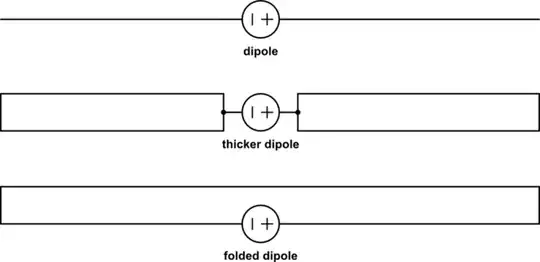
For all practical purposes, the radiation efficiency of a folded dipole versus an ordinary dipole is the same. Consider, they are essentially the same antenna.

schematic

simulate this circuit – Schematic created using CircuitLab

The only difference is that in the folded dipole, we've replaced the feedpoint with a short. Since the Thévenin equivalent resistance of a voltage source is 0Ω, this doesn't make a lick of difference to the currents in the antenna. The currents are the same, the fields are the same. Everything is the same, except that the voltage source now sees only half the current.

So then, what is there that could affect radiation efficiency? There is nothing. There might be some difference in ohmic losses, depending on if you allow the folded dipole to have twice as much copper or not, but this is a very small contributor to loss.

More significant for terrestrial antennas is ground losses in the Earth, but having established that the fields around a dipole and a folded dipole are the same, how could the losses be different? They aren't. The same reasoning applies to any other kind of loss.

Phil Frost - W8II
  • 52,635
  • 8
  • 91
  • 225
0

Beg to differ. The effective conductor radius is increased to something like half the wire spacing. That means that there is less loss. An alternative view is that the impedance transformation properties of the antenna imply that less current flows on either conductor than would be the case for an single-wire dipole. The resistance of the wires is therefore of relatively less concern.

Practically speaking, the differences are indeed small, specially at HF, but they become more important at VHF or UHF.

On the receive side, the susceptibility to noise can be different I believe.

G4ZLZ
  • 137
  • 1
  • 2
-3

The folded dipole antenna has lower efficiency than a standard dipole antenna. The efficiency is a factor of both radiation efficiency and impedance matching.

The radiation efficiency of a folded dipole is lower than that of a standard dipole. This is because it is folded; between the two parallel wires of the structure, there is a capacitive effect. This means some part of the electromagnetic energy is stored between these two parallel wires.

The impedance of a folded dipole also differs from a standard dipole, but the impedance can be matched by using a matching network or a transformer.

About the capaticitive energy stored in parallel wire, you can think about a typical explanation of a dipole antenna. If there are two plates parallel, then it acts like a capacitance and if you put them like a dipole antenna, the rods of the antenna gets + and - poles. Then the antenna radiates. That's because the electric field is not stored between two plates, but the field vector is between one pole to another pole. This provides an antenna to radiate. For example, if the angle between two rods are 120 degrees, then it is more like a capacitance then a standart dipole antenna. And a capacitance means the energy is stored in the capacitance. This is a well known principle in small antenna and mobile phone antenna design. In a transmission line, the electric field vectors are between the two plates, and energy is still stored between the plates.