We just had snow and ice overnight and my wire dipole was coated in ice. Why does the ice covering negatively affect the SWR of the antenna?
Asked
Active
Viewed 4,807 times


4 Answers
3
A heavy coating of ice or snow is likely to short the feedpoint of the antenna. Compare:

simulate this circuit – Schematic created using CircuitLab
Even if the wires and feedpoint are protected by insulation and the ice isn't directly touching, a thick coating of ice will make a tube around the wires, and the resulting capacitive coupling is a low impedance at RF. (ANT3)
Snow or ice isn't a great conductor, but it's a much better conductor than the air or PTFE insulator that was between the halves of the antenna. Clearly the antenna impedance, and thus the SWR, will be affected.
The change in temperature, dielectric constant, and other things mentioned in other answers do affect the antenna impedance, but not to a very significant degree. I'd wager that 80% of the times you sit down in the morning after a storm to find the SWR is all messed up, it's because there's water in the feedpoint. The other 20% of the time, it's because the antenna is sagging into a tree or the ground or broken from the additional weight.

Phil Frost - W8II
- 52,635
- 8
- 91
- 225
2
Ice and water has very big dielectric permittivity. If the antenna is in a dielectric, so the resonance frequency changes with the square root of it. So for ice the dielectric permittivity may change due to its density. Water has dielectic permittivity of 80. So the antenna resonance frequency changes with the ratio 1/squareroot (80). It doesn't guarantee that the antenna works well at the new frequency, because 80 is very high permittivity wich can create high reflection, but it works better at this frequency. That's why the antenna doesn't work when it has ice on it. It is not about the change of antenna length or anything else because of temperature. If you want to solve this problem you must have heat resistance wires on it in order not to have ice on it.

Communicationantennas.com
- 131
- 1
- 1
- 5
0
The increasing SWR means that some of the transmitted power is reflected back to your transmitter. There are several possible explanations for the effect:
The ice is not completely dry and it partially short circuits (through some resistance) the two arms of your dipole. This way the impedance seen at the feed port of the antenna is lower than it is meant to be making the matching worse.
The feed port and the dipole arms are properly insulated from the melting ice but there is still some conductance in the ice layer: this prevents the radiated field from being transmitted to the free space increasing the power reflected towards the transmitter. This would more or less correspond to a situation where you have a (poorly) conducting box around your antenna.
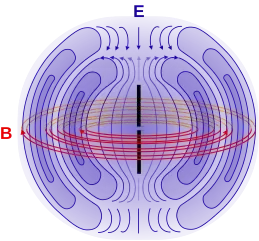
The third possible explanation is related to the reactive near fields surrounding the antenna (see the image below). The impedance of a dipole is determined by the radiation resistance, capacitance between dipole arms, and the inductance of the dipole wire. (See my answer to a related question). If you coat your dipole with ice ($\epsilon \approx 3$) the capacitance between the dipole arms is increased dragging the resonance frequency lower.
It is not easy to say what is the correct explanation for this specific case. If you can plot the SWR as function of frequency with and without the ice and see a clear shift in the resonance frequency, number three would be my suspect. If the ice is near melting and the SWR is poor at all frequencies, the explanation 1 would be my guess.


-1
Assuming we aren't worried about water intrusion into the center insulator or any of the feedline connections, any of which could raise the SWR, the increased SWR is probably due to water ice acting as an insulator on the wire antenna.
This, of course, detunes the antenna. The dielectric constant of normal wire insulation (polyethylene) is about 2.1 whereas water has a dielectric constant of about 5. This means the antenna is suddenly too long for the intended frequency because the velocity factor of the conductor is now higher than it was when the antenna was cut.

WPrecht
- 6,540
- 22
- 43