For three phase electricity the wave is offset by 120 degrees(2\$\pi/3\$ Rad). Why aren't the phases closer together? Is it because it will affect the frequency of the phases? How was this 120 degrees chosen?
For three phase electricity the wave is offset by 120 degrees(2\$\pi/3\$ Rad). Why aren't the phases closer together? Is it because it will affect the frequency of the phases? How was this 120 degrees chosen?


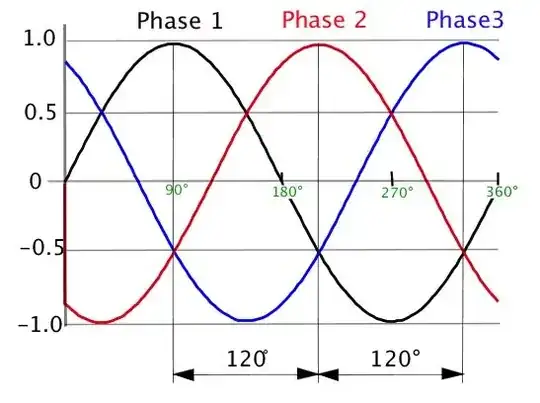
When there's 120° between phases the sum of the voltages at any time will be zero.

This means that with a balanced load no current flows in the return line (neutral).

Also, if each phase is 230V with respect to the neutral (star operation), then there will be 230V \$\times\$ \$\sqrt{3}\$ = 400V between any two phases (triangle or delta operation), and they're also equally spaced, i.e. at 120° angles.
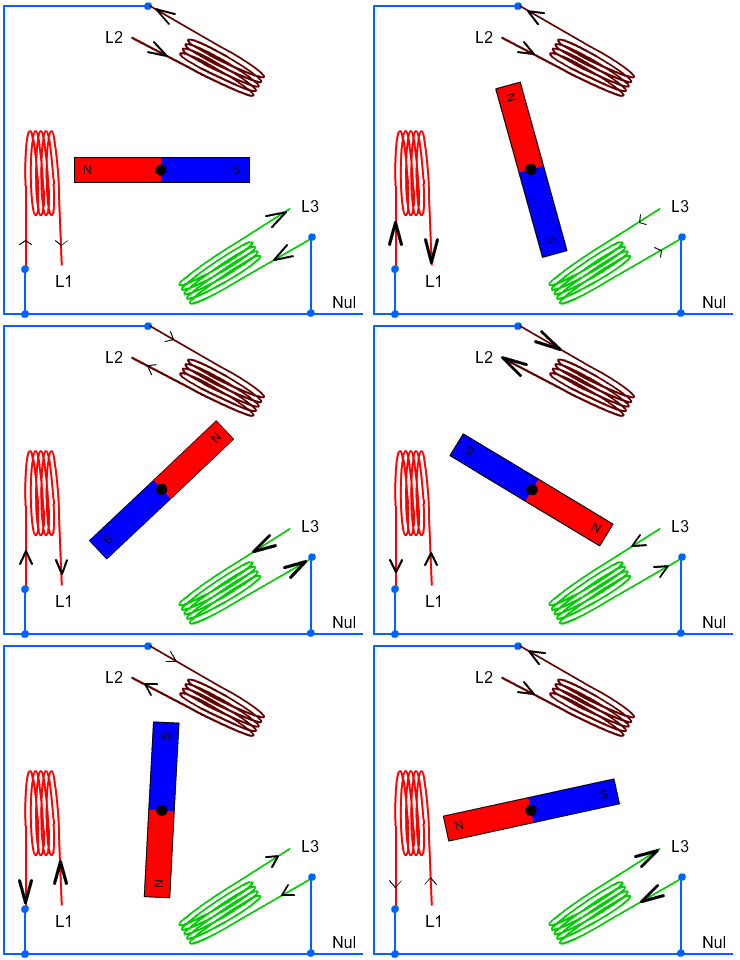
(images from http://www.electrician2.com/electa1/electa3htm.htm)


Being 120 degrees apart makes the phases balanced such that power transfer at any instant is a constant. If you had phases 'closer together' as you suggest, there wouldn't be any real advantage over single phase power.

In principle, any power generator has a rotor with magents and coil on the periphery, one rotation of rotor is one cycle of 360 degrees.
Suppose the generator has one magnet and one coil,then as the magnet/rotor rotates one turn,the voltage generated in the coil gradually rises and reaches peak(max) when the coil comes closest to the magnet and reduces gradually as the magnet moves away.
Suppose we connect the bulb then the flicker rate is clearly visble. This is called 360 deg, single phase AC.
Now, suppose the generator has two magnets and two coils placed equidistantly, then the flicker rate is increased, it is 2-phase , 360/2=180 degrees AC.
Say generator has 3 magnets and 3 coils placed equidistantly, then the flicker rate is much increased; it is 3 phase with 360/3=120 degrees AC.
if we have 4 magnets and 4 coils placed equidistantly then the flicker rate is much more increased (not visible), then it is 4-phase with 360/4=90 degrees, 4-phase AC.
In practice, 3-phase is much more suitable for design.

By separating the phases by 120° one keeps the voltage peaks (for instance) evenly spaced. For example, 60 Hz has peaks every 16.66 msec, so phase A, B, C peaks would come one third of that time apart, in this pattern: A-5.55ms-B-5.55ms-C-5.55ms-A. If one separated phases A & C from B by, say 100° then phases C and A would be separated by 160°, and the pattern of peaks would be A-4.63ms-B-4.63ms-C-7.40ms-A.
Such a stuttering set of phases (with, say, 100°, 100°, 160° separation) would entail many inefficient, unnecessary consequences, not least of which would be designing an AC motor which could effectively use the staggering impulses of such syncopated voltage peaks.

Most of the electric energy is made by AC generators.
2/3 of electric energy is used by AC electric motors (electric energy in - mechanical energy out), they are built very similar to the electric generators (mechanical energy in - electric energy out).
In order to create a rotation in AC electric motors you need to have equally spaced windings in the stator fed by equally spaced magnetic fields; equally spaced magnetic fields are created by equally spaced currents (this answers your question of the 120 degrees for the 3 phase system).
The reason of using 3 phases instead of 2, 6 or 12 it's because it's the most efficient system (having 2 would mean more power losses during transmission, having 6 phases would mean to transport the energy with 6 wires instead of 3).

Also keep in mind that the phase to phase voltage would drop tremendously with more phases. You would only be able to use it phase to ground if you added more phases. With a regular wye transformer, we can still have equipment be on 208 volts and 240 single phase. Add more phases it would be a lot more harder to add 3 phase equipment or more.