I have a square wave signal whose rise and fall times are too big to feed into another 74xx-series logic chip, such as the 74HC175 flip-flop, which requires rise and fall times in the nanosecond range.
I've tried feeding the square wave signal through a 74HCT14 schmitt trigger inverter, like this:

I've built the circuit on a bread board with components that were just lying around - so it's a bit messy:

Now, rise and fall times doesn't seem to improve when i feed the signal through the schmitt trigger (yellow: input, blue: output):


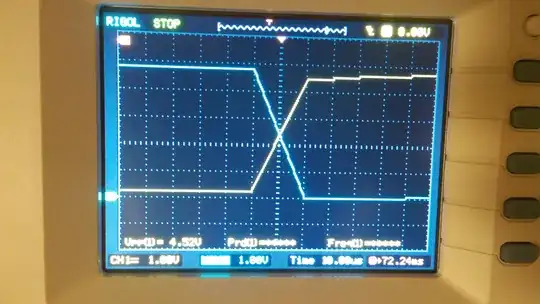
As can be seen, rise and fall times are roughly the same. Also, I find it a bit strange that in the two last pictures the output signal begins transitioning before the input signal has passed Vt+.
The data sheet can be found here: http://www.ti.com/lit/ds/symlink/sn74hc14.pdf


You always need a 0.1uF ceramic capacitor close to each IC, to provide the peak current so the device can operate correctly.
Ceramic caps have higher SRF, so they behave like capacitors over a higher range of frequenies, and can supply more peak current to a local IC.
– MarkU May 27 '14 at 02:16See also this question http://electronics.stackexchange.com/questions/59325/whats-the-use-of-a-decoupling-capacitor-near-a-reservoir-capacitor
– MarkU May 27 '14 at 02:58