Watarase Keikoku Line
| Watarase Keikoku Line | |
|---|---|
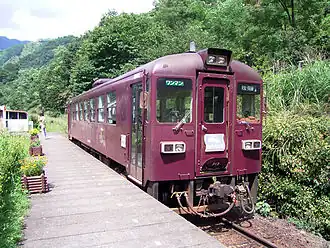 Watarase Keikoku Railway Wa 89-313 train. | |
| Overview | |
| Native name | わたらせ渓谷線 |
| Termini | |
| Stations | 17 |
| History | |
| Opened | 15 April 1911 |
| Technical | |
| Line length | 44.1 km (27.4 mi) |
| Number of tracks | 1 |
| Track gauge | 1,067 mm (3 ft 6 in) |
| Operating speed | 75 km/h (47 mph) (Maximum) |
| Train protection system | ATS-P ATS-S N |
The Watarase Keikoku Line (わたらせ渓谷線, Watarase Keikoku-sen) is a Japanese railway line connecting Kiryū Station in Kiryū, Gunma and Matō Station in Nikkō, Tochigi. This is the only railway line that the third-sector company Watarase Keikoku Railway (わたらせ渓谷鐵道, Watarase Keikoku Tetsudō) operates. The company and line are also known as Watakei (わた渓) or Watetsu (わ鐵). The company acquired the line from the East Japan Railway Company (JR East) in 1989. As the name suggests, the line runs along the Watarase River through a deep valley.
History
The Ashio Railway Co. opened the line to Ashio-Motoyama (2 kilometres or 1.2 miles beyond Mato) in 1911–12 to service the Ashio Copper Mine, and leased the line to JNR in 1913. Passenger services were introduced in 1914. In 1918 the line was nationalised.[1]
The copper mine closed in 1973, the same year the line was deviated for the construction of the Kusaki Dam,[1] including the 5,242-metre (17,198 ft) Kusaki Tunnel.
Operation of the line between Kiryū and Matō was transferred to the Watarase Keikoku Railway, a third-sector company, in 1989.[2] Also in 1989, the Ashio-Motoyama – Mato section was closed.
Basic data
- Distance: 44.1 km (27.4 mi)
- Gauge: 1,067 mm (3 ft 6 in)
- Stations: 17
- Double-tracking: None
- Electrification: None
- Railway signalling:
- Kiryū — Shimo-Shinden: Automatic
- Shimo-Shinden — Matō: Simplified Automatic
Station list
- Trains stop at stations marked "●" and pass those marked "|".
- Local trains stop at all stations (other than Shimo-Shinden Signal Box).
| Station No. | Station | Japanese | Watarase Keikoku-gō | Transfers | Location | |
|---|---|---|---|---|---|---|
| WK01 | Kiryū | 桐生 | East Japan Railway Company (JR East): Ryōmō Line Jōmō Electric Railway: Jōmō Line (Nishi-Kiryū) |
Kiryū | Gunma | |
| WK02 | Shimo-Shinden | 下新田 | ||||
| WK03 | Aioi | 相老 | ※ | Tōbu Railway: Kiryū Line | ||
| WK04 | Undō-Kōen | 運動公園 | | | Jōmō Electric Railway: Jōmō Line (Kiryū-Kyūjō-Mae) | ||
| WK05 | Ōmama | 大間々 | ● | Tōbu: Kiryū Line (Akagi) Jōmō Electric Railway: Jōmō Line (Akagi) |
Midori | |
| WK06 | Kami-Kambai | 上神梅 | | | |||
| WK07 | Motojuku | 本宿 | | | Kiryū | ||
| WK08 | Mizunuma | 水沼 | ● | |||
| WK09 | Hanawa | 花輪 | | | Midori | ||
| WK10 | Nakano | 中野 | | | |||
| WK11 | Konaka | 小中 | | | |||
| WK12 | Gōdo | 神戸 | ● | |||
| WK13 | Sōri | 沢入 | ● | |||
| WK14 | Haramukō | 原向 | | | Nikkō | Tochigi | |
| WK15 | Tsūdō | 通洞 | ● | |||
| WK16 | Ashio | 足尾 | ● | |||
| WK17 | Matō | 間藤 | ||||
References
External links

- Watarase Keikoku Railway official website (in Japanese)