Voiced retroflex plosive
| Voiced retroflex plosive | |||
|---|---|---|---|
| ɖ | |||
| IPA number | 106 | ||
| Audio sample | |||
|
source · help | |||
| Encoding | |||
| Entity (decimal) | ɖ | ||
| Unicode (hex) | U+0256 | ||
| X-SAMPA | d` | ||
| Braille |   | ||
| |||

The voiced retroflex plosive or stop is a type of consonantal sound, used in some spoken languages. The symbol in the International Phonetic Alphabet that represents this sound is ⟨ɖ ⟩. Like all the retroflex consonants, the IPA symbol is formed by adding a rightward-pointing hook extending from the bottom of a d, the letter that is used for the corresponding alveolar consonant. Many South Asian languages, such as Hindi and Urdu, have a two-way contrast between plain and murmured (breathy voice) [ɖ ].
Features
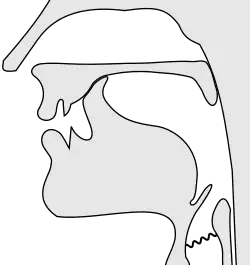
Features of the voiced retroflex stop:
- Its manner of articulation is occlusive, which means it is produced by obstructing airflow in the vocal tract. Since the consonant is also oral, with no nasal outlet, the airflow is blocked entirely, and the consonant is a plosive.
- Its place of articulation is retroflex, which prototypically means it is articulated subapical (with the tip of the tongue curled up), but more generally, it means that it is postalveolar without being palatalized. That is, besides the prototypical subapical articulation, the tongue can be apical (pointed) or, in some fricatives, laminal (flat).
- Its phonation is voiced, which means the vocal cords vibrate during the articulation.
- It is an oral consonant, which means that air is exclusively allowed to escape through the mouth.
- It is a central consonant, which means it is produced by directing the airstream along the center of the tongue, rather than to the sides.
- Its airstream mechanism is pulmonic, which means it is articulated by pushing air solely with the intercostal muscles and abdominal muscles, as in most sounds.
Occurrence
| Language | Word | IPA | Meaning | Notes | |
|---|---|---|---|---|---|
| Asturian | Astierna dialect | ḷḷingua | [ɖiŋɡwä] | 'tongue' | Corresponds to /ʎ/ in other dialects. See Che Vaqueira |
| Balochi | ڈل/dèl | [ɖɪl] | 'female donkey' | ||
| Bengali[1] | ডাকাত | [ɖakat̪] | 'robber' | Apical postalveolar.[1] See Bengali phonology | |
| English | Indian dialects | dine | [ɖaɪn] | 'to eat' | Corresponds to /d/ in other dialects. See English phonology |
| General American | herd | [hɚɖ] | 'herd' | Allophone of /d/ before /ɹ/ or /ɚ/ | |
| Fon | ɖù | [ɖù] | 'to celebrate' | ||
| Gujarati[2] | હાડ | [ɦaɖ] | 'bone' | Subapical.[2] See Gujarati phonology | |
| Hindustani[3][4] | डालना/ڈالنا | [ɖaːlnaː] | 'to put' | Apical postalveolar.[4] See Hindustani phonology | |
| Javanese | ꦣꦲꦂ/dhahar/ڎاهار | [ɖahaɽ] | 'to eat' | ||
| Kannada | ಅಡಸು | [ɐɖɐsu] | 'to join' | ||
| Maba | kodrok/كٛڔٛك | [kɔɖɔk] | 'false' | ||
| Malayalam | പാണ്ഡവർ | [ˈpaːɳɖaʋɐr] | 'Pandavas' | ||
| Marathi[2] | हाड | [haːɖ] | 'bone' | Subapical.[2] See Marathi phonology | |
| Nepali | डर | [ɖʌr] | 'fear' | Apical postalveolar. See Nepali phonology | |
| Nihali | [biɖum] | 'one' | |||
| Norwegian | varde | [ˈʋɑɖːə] | 'beacon' | See Norwegian phonology | |
| Odia | ଡଙ୍ଗା/ḍaṅgā | [ɖɔŋga] | 'boat' | Apical postalveolar. | |
| Pashto | ډﻙ | [ɖak] | 'full' | ||
| Punjabi | ਡੱਡੂ | [ɖəɖːu] | 'frog' | ||
| Sardinian | cherveddu | ⓘ | 'brain' | ||
| Sicilian | coḍḍu | [kɔɖːu] | 'neck' | ||
| Sindhi | واڍو/vāḍho/वाढो | [ʋɑɖʱo] | 'carpenter' | ||
| Sinhala | බඩ | [baɖə] | 'stomach' | ||
| Somali | dhul | [ɖul] | 'earth, land, ground' | See Somali phonology | |
| Swedish | nord | ⓘ | 'north' | See Swedish phonology | |
| Tamil[2][5] | வண்டி | [ʋəɳɖi] | 'cart' | Subapical;[2] allophone of /ʈ/.[5] See Tamil phonology | |
| Telugu | కడ్డి | [kɐɖːi] | 'rod' | Contrasts unaspirated and aspirated forms. Aspirated form articulated as breathy consonant. | |
| Torwali[6] | ڈىغو | [ɖiɣu] | 'late afternoon' | Realised as [ɽ] between vowels. | |
See also
Notes
- ^ a b Mazumdar (2000:57)
- ^ a b c d e f Khatiwada (2009:374)
- ^ Ladefoged (2005:141)
- ^ a b Tiwari (2004:?)
- ^ a b Keane (2004:111)
- ^ Lunsford (2001:11–16)
References
- Keane, Elinor (2004), "Tamil", Journal of the International Phonetic Association, 34 (1): 111–116, doi:10.1017/S0025100304001549
- Khatiwada, Rajesh (2009), "Nepali", Journal of the International Phonetic Association, 39 (3): 337–380, doi:10.1017/s0025100309990181
- Ladefoged, Peter (2005), Vowels and Consonants (Second ed.), Blackwell
- Ladefoged, Peter; Maddieson, Ian (1996), The Sounds of the World's Languages, Oxford: Blackwell, ISBN 0-631-19815-6
- Lunsford, Wayne A. (2001), "An overview of linguistic structures in Torwali, a language of Northern Pakistan" (PDF), M.A. Thesis, University of Texas at Arlington
- Masica, Colin P. (1991), The Indo-Aryan Languages, Cambridge University Press, ISBN 0-521-29944-6
- Mazumdar, Bijaychandra (2000) [First published 1920], The history of the Bengali language, New Delhi: Asian Educational Services, ISBN 8120614526
- Tiwari, Bholanath (2004) [First published 1966], Hindī Bhāshā, Kitāb Mahal: Kitāb Mahal, ISBN 81-225-0017-X