Portal:Cetaceans

The Cetaceans Portal
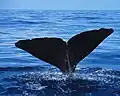
Cetacea (/sɪˈteɪʃə/; from Latin cetus 'whale', from Ancient Greek κῆτος (kêtos) 'huge fish, sea monster') is an infraorder of aquatic mammals belonging to the order Artiodactyla that includes whales, dolphins and porpoises. Key characteristics are their fully aquatic lifestyle, streamlined body shape, often large size and exclusively carnivorous diet. They propel themselves through the water with powerful up-and-down movements of their tail, which ends in a paddle-like fluke, using their flipper-shaped forelimbs to steer.
While the majority of cetaceans live in marine environments, a small number reside solely in brackish or fresh water. Having a cosmopolitan distribution, they can be found in some rivers and all of Earth's oceans, and many species migrate throughout vast ranges with the changing of the seasons.
Cetaceans are famous for their high intelligence, complex social behaviour, and the enormous size of some of the group's members. For example, the blue whale reaches a maximum confirmed length of 29.9 meters (98 feet) and a weight of 173 tonnes (190 short tons), making it the largest animal ever known to have existed.
There are approximately 90 living species split into two parvorders: the Odontoceti or toothed whales, which contains 75 species including porpoises, dolphins, other predatory whales like the beluga and sperm whale, and the beaked whales and the filter feeding Mysticeti or baleen whales, which contains 15 species and includes the blue whale, the humpback whale and the bowhead whale, among others. Despite their highly modified bodies and carnivorous lifestyle, genetic and fossil evidence places cetaceans within the even-toed ungulates, most closely related to hippopotamus. (Full article...)
 Recognized content -
-

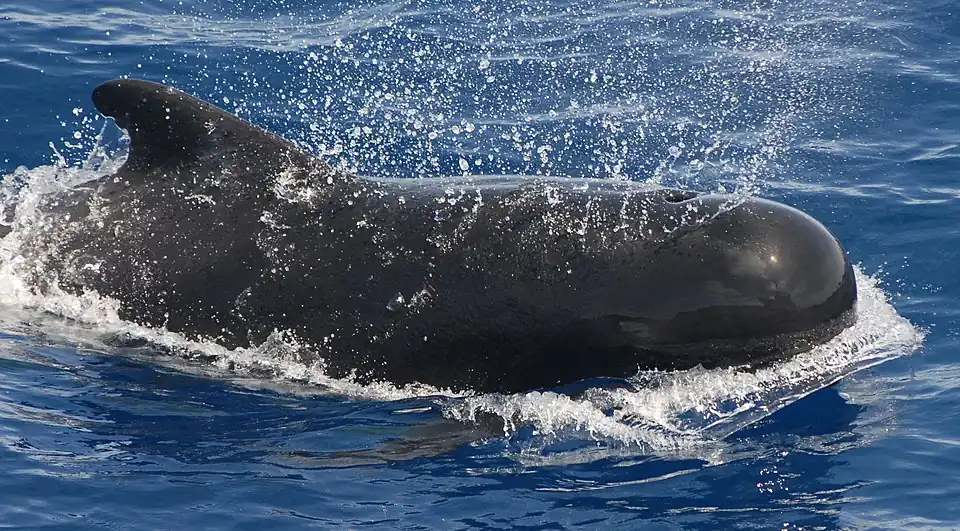
Pilot whales are cetaceans belonging to the genus Globicephala. The two extant species are the long-finned pilot whale (G. melas) and the short-finned pilot whale (G. macrorhynchus). The two are not readily distinguishable at sea, and analysis of the skulls is the best way to distinguish between the species. Between the two species, they range nearly worldwide, with long-finned pilot whales living in colder waters and short-finned pilot whales living in tropical and subtropical waters. Pilot whales are among the largest of the oceanic dolphins, exceeded in size only by the orca. They and other large members of the dolphin family are also known as blackfish.
Pilot whales feed primarily on squid, but will also hunt large demersal fish such as cod and turbot. They are highly social and may remain with their birth pod throughout their lifetime. Short-finned pilot whales are one of the few non-primate mammal species in which females go through menopause, and postreproductive females continue to contribute to their pod. Pilot whales are notorious for stranding themselves on beaches, but the reason behind this is not fully understood. Marine biologists have shed some light on the matter, suggesting that it is due to the mammals inner ear (their principal navigational sonar) being damaged from noise pollution in the ocean, such as from cargo ships or military exercises. The conservation status of short-finned and long-finned pilot whales has been determined to be least concern. (Full article...) -
Baleen whales (/bəˈliːn/), also known as whalebone whales, are marine mammals of the parvorder Mysticeti in the infraorder Cetacea (whales, dolphins and porpoises), which use baleen plates (or "whalebone") in their mouths to sieve plankton from the water. Mysticeti comprises the families Balaenidae (right and bowhead whales), Balaenopteridae (rorquals), Eschrichtiidae (the gray whale) and Cetotheriidae (the pygmy right whale). There are currently 16 species of baleen whales. While cetaceans were historically thought to have descended from mesonychians, molecular evidence instead supports them as a clade of even-toed ungulates (Artiodactyla). Baleen whales split from toothed whales (Odontoceti) around 34 million years ago.
Baleen whales range in size from the 6 m (20 ft) and 3,000 kg (6,600 lb) pygmy right whale to the 31 m (102 ft) and 190 t (210 short tons) blue whale, the largest known animal to have ever existed. They are sexually dimorphic. Baleen whales can have streamlined or large bodies, depending on the feeding behavior, and two limbs that are modified into flippers. The fin whale is the fastest baleen whale, recorded swimming at 10 m/s (36 km/h; 22 mph). Baleen whales use their baleen plates to filter out food from the water by either lunge-feeding or skim-feeding. Baleen whales have fused neck vertebrae, and are unable to turn their heads at all. Baleen whales have two blowholes. Some species are well adapted for diving to great depths. They have a layer of fat, or blubber, under the skin to keep warm in the cold water. (Full article...) -
Janjucetus is an extinct genus of baleen whale that lived during the Late Oligocene (Chattian) in south-east Australia, around 25 million years ago. Remains of the genus have been found in the Jan Juc Marl in the Jan Juc Formation near the township of the same name, and have been assigned to two species: the type species J. hunderi and J. dullardi. This locality has yielded remains of more extinct cetaceans, including Prosqualodon, Waipatia, and the related Mammalodon.
Unlike modern mysticetes, it possessed large teeth for gripping and shredding prey instead of baleen, and was therefore likely to have been a predator that captured individual large prey animals rather than filter feeding. However, it has been noted that the teeth of Junjucetus may have interlocked like those of the modern-day filter-feeding crabeater seal (Lobodon carcinophaga), which would have given it a limited filter-feeding capacity. At the same time the closest relative to the crabeater seal is the leopard seal (Hydrurga leptonyx), known to have had somewhat similar dentition, although its ecology mostly involves hunting larger prey, leading to the idea that Janjucetus may have fed on large fish. The animal possessed unusually large eyes, suggesting that an acute sense of vision may have aided it in hunting. (Full article...) -

Species of the infraorder Cetacea
The evolution of cetaceans is thought to have begun in the Indian subcontinent from even-toed ungulates (Artiodactyla) 50 million years ago (mya) and to have proceeded over a period of at least 15 million years. Cetaceans are fully aquatic mammals belonging to the order Artiodactyla and branched off from other artiodactyls around 50 mya. Cetaceans are thought to have evolved during the Eocene (56-34 mya), the second epoch of the present-extending Cenozoic Era. Molecular and morphological analyses suggest Cetacea share a relatively recent closest common ancestor with hippopotamuses and that they are sister groups.
Being mammals, they surface to breathe air; they have five finger bones (even-toed) in their fins; they nurse their young; and, despite their fully aquatic life style, they retain many skeletal features from their terrestrial ancestors. Research conducted in the late 1970s in Pakistan revealed several stages in the transition of cetaceans from land to sea. (Full article...) -
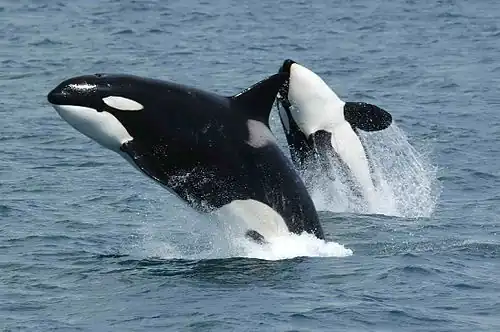
The orca (Orcinus orca), or killer whale, is a toothed whale and the largest member of the oceanic dolphin family. The only extant species in the genus Orcinus, it is recognizable by its distinct pigmentation; being mostly black on top, white on the bottom and having recognizable white eye patches. A cosmopolitan species, it inhabits a wide range of marine environments, from Arctic to Antarctic regions to tropical seas, but is more commonly documented in temperate or cooler coastal waters. Scientists have proposed dividing the global population into races, subspecies, or possibly even species.
Orcas are apex predators with a diverse diet. Individual populations often specialize in particular types of prey, including fish, sharks, rays, and marine mammals such as seals, dolphins, and whales. They are highly social, with some populations forming stable matrilineal family groups (pods). Their sophisticated hunting techniques and vocal behaviors, often unique to specific groups and passed down from generation to generation, are considered to be manifestations of animal culture. The most studied populations are off the west coast of North America, which include fish-eating "residents", mammal-eating "transients", and offshores. (Full article...) -
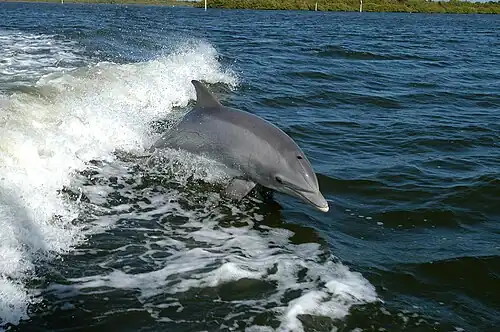
The bottlenose dolphin is a toothed whale in the genus Tursiops. They are common, cosmopolitan members of the family Delphinidae, the family of oceanic dolphins. Molecular studies show the genus contains three species: the common bottlenose dolphin (Tursiops truncatus), the Indo-Pacific bottlenose dolphin (Tursiops aduncus), and Tamanend's bottlenose dolphin (Tursiops erebennus). Others, like the Burrunan dolphin (Tursiops (aduncus) australis), may be alternately considered their own species or be subspecies of T. aduncus. Bottlenose dolphins inhabit warm and temperate seas worldwide, being found everywhere except for the Arctic and Antarctic Circle regions. Their name derives from the Latin tursio (dolphin) and truncatus for the truncated teeth (the type specimen was old and had worn down teeth; this is not a typical characteristic of most members of the species).
Numerous investigations of bottlenose dolphin intelligence have been conducted, examining mimicry, use of artificial language, object categorization, and self-recognition. They can use tools (sponging; using marine sponges to forage for food sources they normally could not access) and transmit cultural knowledge from generation to generation, and their considerable intelligence has driven interaction with humans. Bottlenose dolphins gained popularity from aquarium shows and television programs such as Flipper. They have also been trained by militaries to locate sea mines or detect and mark enemy divers. In some areas, they cooperate with local fishermen by driving fish into their nets and eating the fish that escape. Some encounters with humans are harmful to the dolphins: people hunt them for food, and dolphins are killed inadvertently as a bycatch of tuna fishing and by getting caught in crab traps. (Full article...) -
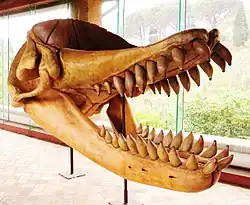
Livyatan is an extinct genus of macroraptorial sperm whale containing one known species: L. melvillei. The genus name was inspired by the biblical sea monster Leviathan, and the species name by Herman Melville, the author of the famous novel Moby-Dick about a white bull sperm whale. Herman Melville often referred to whales as "Leviathans" in his book. It is mainly known from the Pisco Formation of Peru during the Tortonian stage of the Miocene epoch, about 9.9–8.9 million years ago (mya); however, finds of isolated teeth from other locations such as Chile, Argentina, the United States (California), South Africa and Australia imply that either it or a close relative survived into the Pliocene, around 5 mya, and may have had a global presence. It was a member of a group of macroraptorial sperm whales (or "raptorial sperm whales") and was probably an apex predator, preying on whales, seals and so forth. Characteristically of raptorial sperm whales, Livyatan had functional, enamel-coated teeth on the upper and lower jaws, as well as several features suitable for hunting large prey.
Livyatan's total length has been estimated to be about 13.5–17.5 m (44–57 ft), almost similar to that of the modern sperm whale (Physeter macrocephalus), making it one of the largest predators known to have existed. The teeth of Livyatan measured 36.2 cm (1.19 ft), and are the largest biting teeth of any known animal, excluding tusks. It is distinguished from the other raptorial sperm whales by the basin on the skull spanning the length of the snout. The spermaceti organ contained in that basin is thought to have been used in echolocation and communication, or for ramming prey and other sperm whales. The whale may have interacted with the large extinct shark megalodon (Otodus megalodon), competing with it for a similar food source. Its extinction was probably caused by a cooling event at the end of the Miocene period causing a reduction in food populations. The geological formation where the whale has been found has also preserved a large assemblage of marine life, such as sharks and other marine mammals. (Full article...) -
Ambulocetus (Latin ambulare "to walk" + cetus "whale") is a genus of early amphibious cetacean from the Kuldana Formation in Pakistan, roughly 48 or 47 million years ago during the Early Eocene (Lutetian). It contains one species, Ambulocetus natans (Latin natans "swimming"), known solely from a near-complete skeleton. Ambulocetus is among the best-studied of Eocene cetaceans, and serves as an instrumental find in the study of cetacean evolution and their transition from land to sea, as it was the first cetacean discovered to preserve a suite of adaptations consistent with an amphibious lifestyle. Ambulocetus is classified in the group Archaeoceti—the ancient forerunners of modern cetaceans whose members span the transition from land to sea—and in the family Ambulocetidae, which includes Himalayacetus and Gandakasia (also from the Eocene of the Indian subcontinent).
Ambulocetus had a narrow, streamlined body, and a long, broad snout, with eyes positioned at the very top of its head. Because of these features, it is hypothesised to have behaved much like a crocodile, waiting near the water's surface to ambush large mammals, using its powerful jaws to clamp onto and drown or thrash prey. Additionally, its ears possessed similar traits to modern cetaceans, which are specialised for hearing and detecting certain frequencies underwater, although it is unclear if Ambulocetus also used these specialised ears for hearing underwater. They may have instead been utilised for bone conduction on land, or perhaps served no function for early cetaceans. (Full article...) -
.jpg)
Atlantic white-sided dolphin caught in a drive hunt in Hvalba on the Faroe Islands being taken away with a forklift
Dolphin drive hunting, also called dolphin drive fishing, is a method of hunting dolphins—and occasionally other small cetaceans—by herding them toward the shore with boats, typically into a bay or onto a beach. Their escape is prevented by closing off the route to the open sea or ocean with boats and nets. Dolphins are hunted this way in several places around the world including the Solomon Islands, the Faroe Islands, Peru, and Japan, which is the most well-known practitioner of the method. In large numbers dolphins are mostly hunted for their meat; some end up in dolphinariums.
Despite the controversial nature of the hunt resulting in international criticism, and the possible health risk that the often polluted meat causes, tens of thousands of dolphins are caught in drive hunts each year. (Full article...) -
The fin whale (Balaenoptera physalus), also known as the finback whale or common rorqual, is a species of baleen whale and the second-longest cetacean after the blue whale. The biggest individual reportedly measured 26–27 m (85–89 ft) in length, with a maximum recorded weight of 70 to 80 tonnes (77 to 88 short tons; 69 to 79 long tons). The fin whale's body is long, slender and brownish-gray in color, with a paler underside to appear less conspicuous from below (countershading).
At least two recognized subspecies exist, one in the North Atlantic and one across the Southern Hemisphere. It is found in all the major oceans, from polar to tropical waters, though it is absent only from waters close to the pack ice at the poles and relatively small areas of water away from the open ocean. The highest population density occurs in temperate and cool waters. Its prey mainly consists of smaller schooling fish, small squid, or crustaceans, including copepods and krill. Mating takes place in temperate, low-latitude seas during the winter. Fin whales are often observed in pods of 6–10 animals, with whom they communicate utilizing frequency-modulated sounds, ranging from 16 to 40 hertz. (Full article...) -
Arktocara is an extinct genus of river dolphin from the Oligocene epoch of Alaska, containing one species, A. yakataga. Having been discovered in 25-million-year-old strata near the 60th parallel north, it is perhaps the oldest-known crown toothed whale and the northmost river dolphin discovered. It was a member of the now-extinct family Allodelphinidae, along with the genera Allodelphis, Goedertius, Ninjadelphis, and Zarhinocetus. It measured approximately 2.26 or 2.28 meters (7.4 or 7.5 ft), comparable to its closest living relative, the South Asian river dolphin, which measures 2.4 meters (7.9 ft). However, the animal probably had an elongated beak and neck, so it may have been longer. The animal is known only from a partially preserved skull. Its ecology may have been similar to the modern-day Dall's porpoise, and it may have competed with contemporaneous delphinoids. Its remains were found in the Poul Creek Formation, which has also yielded several mollusk species. (Full article...) -
Rice's whale (Balaenoptera ricei), also known as the Gulf of Mexico whale, is a species of baleen whale endemic to the northern Gulf of Mexico. Initially identified as a subpopulation of the Bryde's whale, genetic and skeletal studies found it to be a distinct species by 2021. In outward appearance, it is virtually identical to the Bryde's whale. Its body is streamlined and sleek, with a uniformly dark charcoal gray dorsal and pale to pinkish underside. A diagnostic feature often used by field scientists to distinguish Rice's whales from whales other than the Bryde's whale is the three prominent ridges that line the top of its head. The species can be distinguished from the Bryde's whale by the shape of the nasal bones, which have wider gaps due to a unique wrapping by the frontal bones, its unique vocal repertoire, and genetic differences.
It is a medium-sized baleen whale that grows up to 12.65 meters (41.5 ft) in length and weighs up to 13.87–27.2 metric tons (13.65–26.77 long tons; 15.29–29.98 short tons). The Rice's whale inhabits a restricted stretch along the continental slope in the northeastern part of the Gulf of Mexico between depths of 150–410 meters (490–1,350 ft) off the coast of western Florida, although some whales have been sighted in the northwestern portions and the species may have inhabited a wider distribution throughout the Gulf in historical times. It does not migrate but remains within this area year-round. Little is known about the feeding behavior of Rice's whales, but data from a tagged individual revealed a diel vertical diving pattern, in which the whale spends most of the day feeding at or near the seafloor at depths of up to 271 meters (889 ft) and night at the surface. The whale's diet remains unknown, but lanternfish and hatchetfish are suspected prey. (Full article...) -
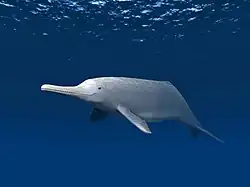
River dolphins are a polyphyletic group of fully aquatic mammals that reside exclusively in freshwater or brackish water. They are an informal grouping of dolphins, which itself is a paraphyletic group within the infraorder Cetacea. Extant river dolphins are placed in two superfamilies, Platanistoidea and Inioidea. They comprise the families Platanistidae (the South Asian dolphins), the possibly extinct Lipotidae (Yangtze River dolphin), Iniidae (the Amazonian dolphins) and Pontoporiidae. There are five extant species of river dolphins. River dolphins, alongside other cetaceans, belong to the clade Artiodactyla, with even-toed ungulates, and their closest living relatives the hippopotamuses, from which they diverged about 40 million years ago. Specific types of dolphins can be pink.
River dolphins are relatively small compared to other dolphins, having evolved to survive in warm, shallow water and strong river currents. They range in size from the 5-foot (1.5 m) long South Asian river dolphin to the 8-foot (2.4 m) and 220-pound (100 kg) Amazon river dolphin. Several species exhibit sexual dimorphism, in that the females are larger than the males. They have streamlined bodies and two limbs that are modified into flippers. River dolphins use their conical-shaped teeth and long beaks to capture fast-moving prey in murky water. They have well-developed hearing that is adapted for both air and water; they do not really rely on vision since their eyes are very small and the water they swim in is usually very muddy. Instead, they tend to rely on echolocation when hunting and navigating. These species are well-adapted to living in warm, shallow waters, and, unlike other cetaceans, have little to no blubber. (Full article...) -

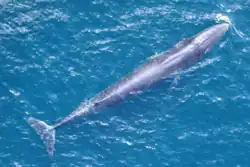
The blue whale (Balaenoptera musculus) is a marine mammal and a baleen whale. Reaching a maximum confirmed length of 29.9–30.5 m (98–100 ft) and weighing up to 190–200 t (190–200 long tons; 210–220 short tons), it is the largest animal known ever to have existed. The blue whale's long and slender body can be of various shades of greyish-blue on its upper surface and somewhat lighter underneath. Four subspecies are recognized: B. m. musculus in the North Atlantic and North Pacific, B. m. intermedia in the Southern Ocean, B. m. brevicauda (the pygmy blue whale) in the Indian Ocean and South Pacific Ocean, and B. m. indica in the Northern Indian Ocean. There is a population in the waters off Chile that may constitute a fifth subspecies.
In general, blue whale populations migrate between their summer feeding areas near the poles and their winter breeding grounds near the tropics. There is also evidence of year-round residencies, and partial or age/sex-based migration. Blue whales are filter feeders; their diet consists almost exclusively of krill. They are generally solitary or gather in small groups, and have no well-defined social structure other than mother–calf bonds. Blue whales vocalize, with a fundamental frequency ranging from 8 to 25 Hz; their vocalizations may vary by region, season, behavior, and time of day. Orcas are their only natural predators. (Full article...) -
Orcinus citoniensis is an extinct species of orca identified in the Late Pliocene of Italy and the Early Pleistocene of England. It was smaller than the modern killer whale (O. orca), 4 m (13 ft) versus 7 to 10 m (23 to 33 ft), and had around 8 more teeth in its jaw. It may have resembled the modern killer whale in appearance, and could represent a transitional species between the modern killer whale and other dolphins. O. citoniensis could have hunted fish and squid in pods, and coexisted with other large predators of the time such as the orcinine Hemisyntrachelus and the extinct shark Otodus megalodon. (Full article...)


.jpg)
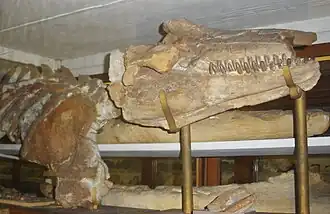
Selected picture
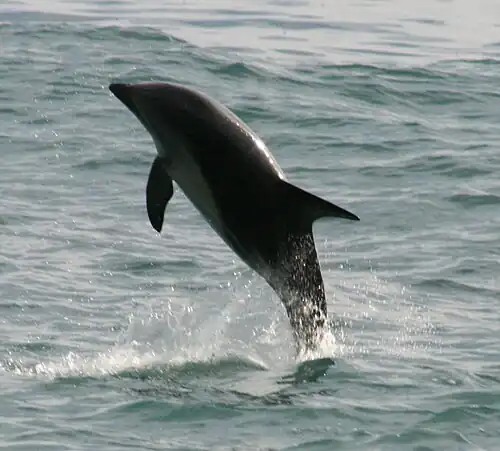
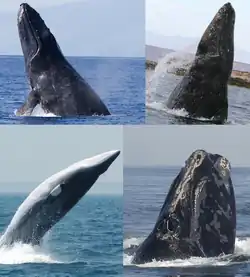
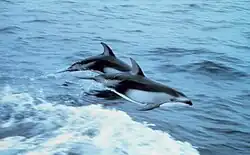
The Dusky Dolphin (Lagenorhynchus obscurus) is a highly gregarious and acrobatic dolphin found in coastal waters in the Southern Hemisphere. It was first identified by John Gray in 1828. It is very closely genetically related to the Pacific White-sided Dolphin, although current scientific consenus is that they are distinct species.
More did you know...
- ...when right whales and humpback whales breach (leap out of the water), seagulls can often be seen darting in to pick up pieces of skin that become dislodged from the breaching whales. Presumably this is an easy source of food for seagulls.
- ...whales and dolphins don’t sleep in the way humans do. Although we don’t know how they sleep, some scientists believe they sleep with half the brain asleep and half the brain awake, keeping them aware of danger.
- ...all whales and dolphins have the remains of the pelvis, but it is reduced to two small bones at the rear of the animal.
- ...the ‘strapped-toothed whale’ is so called because in mature males there are only two teeth in the bottom jaw and these completely ‘strap’ the upper jaw, preventing it from opening more than a few centimetres. How these animals eat is unknown, but it may be that they stun their prey with high intensity sound.
- ...some cetaceans can dive to depths of more than a kilometre and stay there for more than an hour.
Things you can do..
 |
Here are some Cetaceans WikiProject tasks you can do.
|
General images -
-
 Orca hunting a Weddell seal (from Toothed whale)
 -
Atlantic white-sided dolphin caught in a drive hunt in Hvalba on the Faroe Islands being taken away with a forklift (from Toothed whale)
-
 Archaeocetes (like this Basilosaurus) had a heterodont dentition (from Evolution of cetaceans)
 -
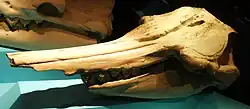 Fossil of Squalodon (from Toothed whale)
 -
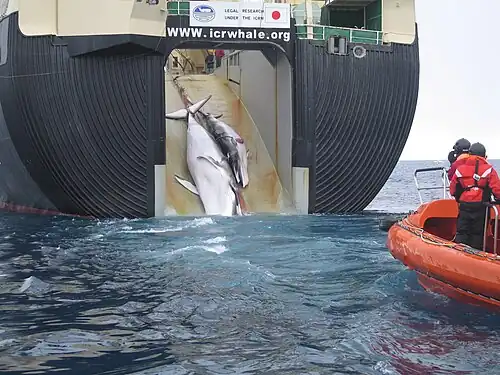 Japanese scientific whaling on a pair of Antarctic minke whales (from Baleen whale)
 -
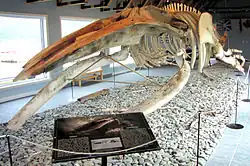 A humpback whale skeleton. Notice how the jaw is split into two.
 -
.svg.png) The nose of the whale is filled with a waxy substance that was widely used in candles, oil lamps, and lubricants (from Toothed whale)
The nose of the whale is filled with a waxy substance that was widely used in candles, oil lamps, and lubricants (from Toothed whale) -
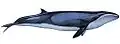 Pygmy right whale illustration
 -
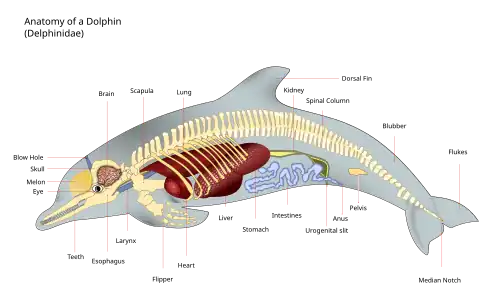 Anatomy of the bottlenose dolphin (from Toothed whale)
 -
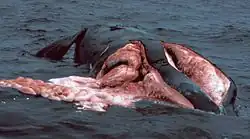 The remains of a North Atlantic right whale after it collided with a ship propeller
 -
Species of the infraorder Cetacea (from Evolution of cetaceans)
-
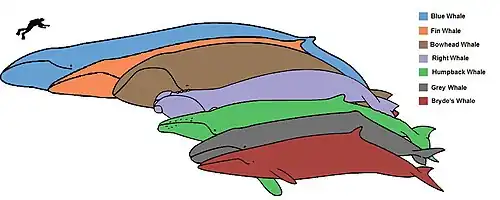 Baleen whales vary considerably in size and shape, depending on their feeding behavior. (from Baleen whale)
 -
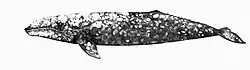 Gray whale illustration
 -
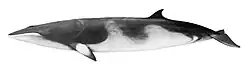 Common minke whale illustration
 -
 Antarctic minke whale illustration
 -
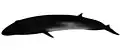 Bryde's whale (rorqual) (from Baleen whale)
 -
 Their eyes are relatively small for their size.
 -
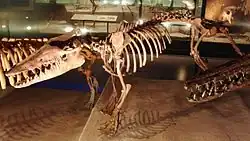 Pakicetus attocki skeleton (from Evolution of cetaceans)
 -
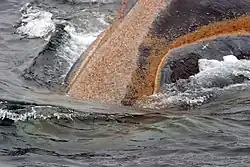 Orange whale lice on a right whale
 -
 A protest against Japan's scientific whaling
 -
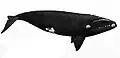 South Atlantic right whale illustration
 -
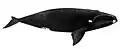 North Atlantic right whale illustration
 -
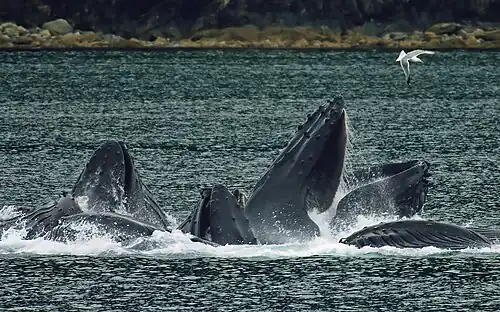 Humpback whales lunge-feeding in the course of bubble net fishing
 -
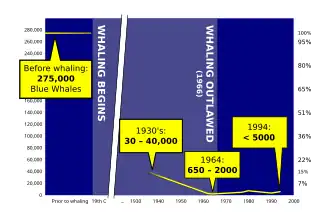 World population graph of blue whales
 -
 The heart of a blue whale with a person standing next to it
 -
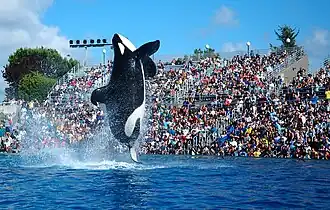 An orca by the name of Ulises performing at SeaWorld, 2009 (from Toothed whale)
 -
 Female right whale with calf
 -
.png) The skeleton of a bowhead whale with the hind limb and pelvic bone structure circled in red. This bone structure stays internal during the entire life of the species. (from Evolution of cetaceans)
The skeleton of a bowhead whale with the hind limb and pelvic bone structure circled in red. This bone structure stays internal during the entire life of the species. (from Evolution of cetaceans) -
-
 Blue whale illustration
 -
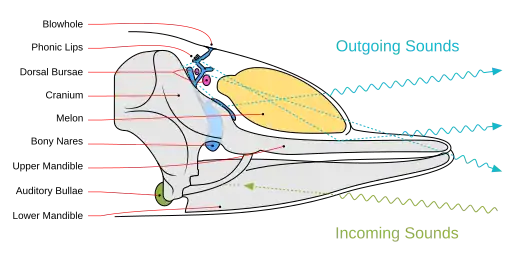 Diagram illustrating sound generation, propagation and reception in a toothed whale. Outgoing sounds are red and incoming ones are green (from Toothed whale)
 -
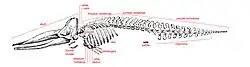 Features of a sperm whale skeleton (from Toothed whale)
 -
_flipped.jpg) Fin whale illustration
Fin whale illustration -
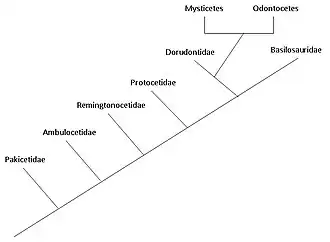 A phylogenetic tree showing the relationships among cetacean families. (from Evolution of cetaceans)
 -
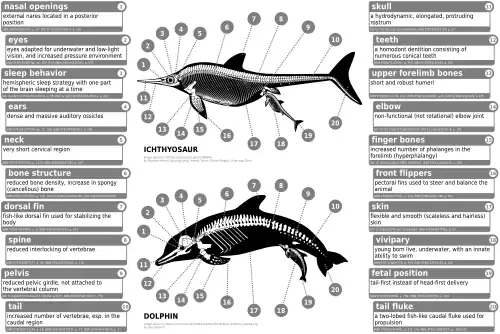 Dolphins (aquatic mammals) and ichthyosaurs (extinct marine reptiles) share a number of unique adaptations for fully aquatic lifestyle and are frequently used as extreme examples of convergent evolution (from Evolution of cetaceans)
 -
 Accessory baleen plates taper off into small hairs (from Baleen whale)
 -
 Spectrogram of dolphin vocalizations. Whistles, whines, and clicks are visible as upside down V's, horizontal striations, and vertical lines, respectively. (from Toothed whale)
 -
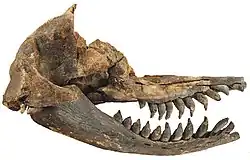 Acrophyseter skull (from Evolution of cetaceans)
 -
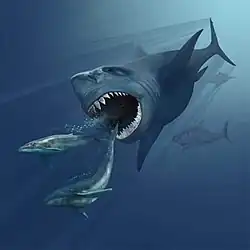 Megalodon hunted Miocene baleen whales (from Baleen whale)
 -
 Bowhead whale illustration
 -
.jpg)
-
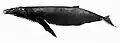 Humpback whale illustration
 -
 Possible relationships between cetaceans and other ungulate groups. (from Evolution of cetaceans)
 -
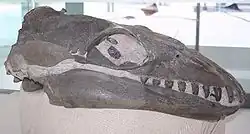 Archaeomysticetes, like Janjucetus, had teeth.
 -
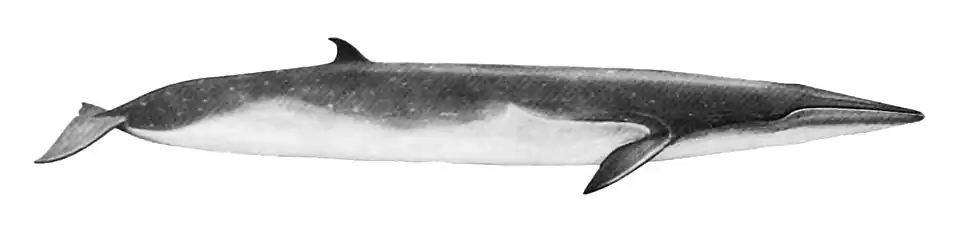 Eden's whale illustration
 -
 Sei whale illustration
 -
 Biosonar by cetaceans (from Toothed whale)
 -
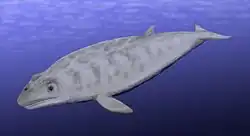 Restoration of Janjucetus hunderi (from Baleen whale)
Did you know (auto-generated)

- ... that the South Asian river dolphin is nearly blind and relies on echolocation for navigation?
- ... that one can swim with humpback whales in the Niue Nukutuluea Multiple-Use Marine Park?
- ... that one of the first researchers to propose dolphin-assisted therapy for humans later renounced it?
- ... that a person required intensive care after being splashed with salt water by a beluga whale?
Selected media
List articles
Related portals
WikiProjects

The content you are reading was created by Wikipedia volunteers. See WikiProject Cetaceans for more.
- Tree of Life
- Biology
- Science
- Birds
- Mammals
- Marine Life
- Sharks
- See also: Wikispecies, a Wikimedia project dedicated to the classification of species.
Cetacean articles
Represents a Featured article, Represents a Good articleCategories

See also
For additional lists of marine life-related featured articles and good articles see:
Associated Wikimedia
The following Wikimedia Foundation sister projects provide more on this subject:
-
 Commons
Free media repository -
 Wikibooks
Free textbooks and manuals -
 Wikidata
Free knowledge base -
 Wikinews
Free-content news -
 Wikiquote
Collection of quotations -
 Wikisource
Free-content library -
 Wikispecies
Directory of species -
 Wikiversity
Free learning tools -
 Wikivoyage
Free travel guide -
 Wiktionary
Dictionary and thesaurus
-
 List of all portals
 -

-

-

-

-

-

-

-

-

-
 Random portal
 -
 WikiProject Portals