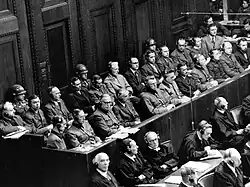
The following is a list of notable physicians in Nazi Germany. This list is primarily split up into those who performed euthanasia through the Aktion T4 campaign, to those who primarily performed experiments on Holocaust victims. While a majority consists of members of the Nazi Party, others who could not become members contributed in notable ways. After the war, the German Medical Association blamed Nazi atrocities on a small group of 350 criminal doctors.[1][2][3] During the Doctors' trial, the defense argued that there was no international law to distinguish between legal and illegal human experimentation,[4] which led to the creation of the Nuremberg Code (1947). Some doctors attempted to change names to escape capture and trial, such as Werner Heyde[5] and Robert Ley,[6] Other doctors, such as Walter Schreiber, were covertly moved to the United States during "Operation Paperclip" in 1951.
Note: Some of those listed here were acquitted of the more serious charges, but were still found guilty for other crimes.
Background
When the Nazi government came to power, they purged Germany of its 6,000 to 7,000 Jewish doctors.[7] Non-Jewish physicians were early recruits to the Nazi Party, due both to social and economic circumstances and to widespread eugenic and Social Darwinist ideas in early-20th-century medicine.[8] By 1942, more than half of all German physicians had become Nazi Party members.[9][10][11] In comparison, only about 10% of the general population became Nazi Party members by 1945.[12] In addition, over 7% of German doctors became members of the Nazi SS, compared to less than 1% of the general population.[13] While most of these doctors were physicians, some held doctorates (PhDs) in biology, anthropology, or related fields. Doctors who were working for the state, and not for their patients, using a Mendelian type of logic chart, saw extermination of their patients as the correct solution to the problem of mental illness and the genetically defective.[14][15][16][17] "The participation in the ‘betrayal of Hippocrates’ had a broad basis within the German medical profession. Without the doctors' active help, the Holocaust could not have happened," wrote E Ernst in the International Journal of Epidemiology.[18] Killing and experimentation[19] became medical procedures as they were performed by licensed doctors. A doctor was present at all the mass killings for legal reasons.[20]
Albrecht was a professor at the University of Berlin, and Karl-Ferdinands-Universität in Prague.
Eugen Fischer
July 5, 1874
July 9, 1967
Fischer developed the physiological specifications, such as skull dimensions, which were used to determine racial origins, and he also developed the so-called Fischer–Saller scale for hair colour. He and the members of his team experimented on Gypsies and African-Germans, drawing their blood and measuring their skulls (see Craniometry) to attempt to scientifically validate his theories.
Wilhelm Frick
March 12, 1877
October 16, 1946
He achieved a doctorate of law and began working for the police in 1903. Later became a politician of the Nazi Party, joining September 1, 1925. He was a contributing creator and writer of the Nuremberg Laws. He was tried and executed after the war.[35]
Rudolf Hippius
June 9, 1905
October 23, 1945
Hippius is best known for his work in "racial psychology" carried out under the auspices of the Nazi regime, and specifically his study of the "suitability" of people of mixed German and Slavonic descent.
Alfred Ploetz
August 22, 1860
March 20, 1940
Ploetz was a eugenicist known for coining the term racial hygiene (Rassenhygiene), a form of eugenics, and for promoting the concept in Germany.
Robert Ritter
May 14, 1901
April 15, 1951
Ritter was appointed head of the Racial Hygiene and Demographic Biology Research Unit of Nazi Germany's Criminal Police. He was the "architect of the experiments, the Roma and Sinti were subjected to." His pseudo-scientific "research" in classifying these populations of Germany aided the Nazi government in their systematic persecution toward a goal of "racial purity".
Ernst Rüdin
April 19, 1874
October 22, 1952
While Rüdin has been credited as a pioneer of psychiatric inheritance studies, he also argued for, designed, justified, and funded the mass sterilization and clinical killing of adults and children.[36]
Wilhelm Stuckart
16 November 1902
15 November 1953
He achieved a doctorate of law in 1930. He worked as a lawyer for the Nazi Party and helped to create and write the Nuremberg Laws.
Otmar Freiherr von Verschuer
July 16, 1896
August 8, 1969
Verschuer was a Nazi-affiliated eugenicist with an interest in racial hygiene. He was an advocate of compulsory sterilization programs in the first half of the 20th century.[37][38]
Hellinger was a member of the Nazi party, who primarily dealt with removing dental gold from those killed at Ravensbrück. During his trial, he claimed that he believed the deceased had been legally executed. On February 3, 1947, he was initially sentenced to 15 years in prison, which was later reduced to time served on May 20, 1954. He re-established his dental practice afterwards until his death.
Wilhelm Jobst
October 27, 1912
May 28, 1947
Jobst was a physician accused of giving injections to terminally ill prisoners in his capacity as camp doctor in Ebensee from 1944 to 1945. He was sentenced to death by hanging on May 13, 1946, and was executed in the following year.
Bruno Kitt was a camp doctor at Auschwitz and Neuengamme after being drafted into the Waffen-SS in March 1942. He was found guilty of participating in the murder and mistreatment of prisoners at the Neuengamme concentration camp and was sentenced to death by hanging on May 3, 1946.
Fritz Klein
November 24, 1888
December 13, 1945
From December 15, 1943, to January 1945, Klein worked at Auschwitz, Birkenau, Neuengamme, and finally Bergen-Belsen as a camp doctor. During his trial, Anita Lasker testified that Klein took part in selections for the gas chamber.[41] Klein was found guilty and was executed by hanging on December 13, 1945.[42]
Franz Lucas
September 15, 1911
December 7, 1994
Franz Lucas worked at Theresienstadt, Mauthausen, Stutthof, and Ravensbrück from mid-December 1943 to late summer 1944. After fleeing west from the Battle of Berlin he was later arrested, and stood trial in Frankfurt. Lucas was found guilty of selecting at least one thousand people in at least four separate selections, and was sentenced on August 20, 1965, to a total of three years and three months imprisonment. After his release, Lucas worked in his private practice until his death on December 7, 1994.
Hans Münch
May 14, 1911
January 27, 2001
Hans was also known as The Good Man of Auschwitz, and worked there as an SS physician from 1943 to 1945 in German occupied Poland. He was acquitted of war crimes at a 1947 trial in Kraków. While Münch made several public remarks later in his life that appeared to support Nazi ideology, it was determined by courts that he was suffering from Alzheimer's. He died in 2001 at the age of 90.
Ernst (Heinrich) Schmidt
March 27, 1912
November 28, 2000
Throughout the war, Schmidt was a camp physician at Buchenwald, Majdanek, Gross-Rosen, Dachau, Boelke Kaserne subcamp, and Bergen-Belsen. After the war, Schmidt testified as a witness in the Belsen Trial on October 25, 1945. Although Schmidt himself was tried in 1947 and 1975 for complicity in war crimes, he was twice acquitted. He later lived in Uetze and died in 2000 in Celle.
Heinz Thilo
October 8, 1911
May 13, 1945
Thilo initially worked as a gynaecologist for the Lebensborn organization. He was later assigned to the Auschwitz concentration camp in July 1942, where he was one of the physicians commonly performing the "selections" for gassing.[43][44] Thilo also participated in the liquidation of the Theresienstadt family camp on July 10–11, 1944, and was transferred to Gross-Rosen where he later served as camp physician until February 1945.[43] After being arrested post-war, Thilo committed suicide in prison.[45]
Adolf Winkelmann
March 26, 1887
February 1, 1947
Winkelmann worked as a medical officer in Częstochowa until December 1, 1944, having reached a peak rank of Hauptsturmführer. After brief assignments at the Groß-Rosen and Sachsenhausen concentration camps, he was later transferred to the Ravensbrück concentration camp at the end of February 1945. After the war, Winkelmann was charged with war crimes but died of a heart attack on February 1, 1947, during trial proceedings.
While the following people were never members of the Nazi Party, their names are included here as they are known to have contributed or are mentioned in a notable way.
Doctor
Birth
Death
Short summary
Hans Asperger
February 18, 1906
October 21, 1980
Asperger's alleged Nazi involvement has been hotly debated as his knowledge and involvement remains unknown.
Alfred Erich Hoche
August 1, 1865
May 16, 1943
While never a party member, Hoche is known for his writings about eugenics and euthanasia.
Yusuf (Bey Murad) Ibrahim
May 27, 1877
February 3, 1953
Ibrahim was associated with Action T4 to an unknown extent. He could not become a member of the Nazi Party due to his half Arabic background
Adolf Pokorny
July 25, 1895
Unknown
Pokorny's entry into the NSDAP in 1939 failed because of Lilly Pokorná's (his ex-wife) Jewish origins.
Gustav Wilhelm Schübbe
March 31, 1910
April 12, 1976
While Schübbe was a witness during the Nuremberg trials, he also admitted to killing thousands of people. He was never a party member himself, and charges against him were later dropped.
Hubertus Strughold
June 15, 1898
September 25, 1986
While Strughold never joined the Nazi Party, his association permanently tarnished his legacy.
Marianne Türk
May 31, 1914
January 11, 2003
Türk was involved with Child euthanasia. During her interrogation at the Vienna People's Court on October 16, 1945, the doctor stated that she was neither interested in politics nor belonged to a political organization. She was given a 10-year sentence for being dependent on her superior.
List of Nazi extermination camps and euthanasia centers
List of Nazi Party leaders and officials
List of last surviving Nazi war criminals
Notes
^These are initial sentences, many of which were later commuted.
^American intervention possibly saved Blome from the gallows in exchange for information about biological warfare, nerve gas, and providing advice on to the American chemical and biological weapons programs.[32]
^Gutzeit was involved in the coordination of pseudo-medical infection tests with hepatitis.
^Handloser held the newly established position of Chief of Wehrmacht Medical Services in the Wehrmacht High Command (OKW). This made him primarily responsible for the entire medical service of the Wehrmacht and consequently also for all medical crimes that were committed within the framework of the Wehrmacht medical service, particularly against prisoners of war.
^Hippke was arrested, but later was released after it was found he was only the source behind the idea for deadly "freezing experiments" on humans.
^Kaschub died before charges could be brought up against him.
^The courts found that Poppendick was aware of almost all the experiments that had been carried out on prisoners in various concentration camps, but saw no criminal liability. He was ultimately sentenced to 10 years for being a member of the SS.
^Rascher never stood trial, he was executed under direct orders from Heinrich Himmler for deception
^Reiter was a "quality control" officer who helped design and implement a process where internees were inoculated with an experimental typhus vaccine. He later assisted the Allies with his knowledge of germ warfare.
^Rostock was charged with complicity in several series of human experiments on concentration camp prisoners due to his high position.
^Witteler was involved in the selection of prisoners who were deliberately infected during Claus Schilling's malaria experiments.
^Wirths was involved in ordering medical experimentation, particularly in gynecological and typhus-related experimental tests.
^This only covers what the person did or allegedly did under the Nazi regime.
^Strous, Rael D. (2006). "Nazi Euthanasia of the Mentally Ill at Hadamar". American Journal of Psychiatry. 163 (1): 27. doi:10.1176/appi.ajp.163.1.27. PMID 16390885.
^Müller-Hill, Benno (April 28, 1988). Murderous science. Oxford University Press. ISBN 9780192615558.
^Hayse, Michael R. (2003). Recasting West German Elites: Higher Civil Servants, Business Leaders, and Physicians in Hesse between Nazism and Democracy, 1945-1955. Oxford: Berghahn Books. ISBN 978-1-57181-271-1.
^McNab, Chris (2011). Hitler's Masterplan: The Essential Facts and Figures for Hitler's Third Reich. London: Amber Books Ltd. pp. 22–23. ISBN 978-1907446962.
^Cesarani, David (2016). Final Solution: The Fate of the Jews, 1933–1945. St. Martin’s Press. p. 282. ISBN 978-1-25000-083-5.
^ abGazdag G, Ungvari GS, Czech H (2017). "Mass killing under the guise of ECT: the darkest chapter in the history of biological psychiatry". Hist Psychiatry. 28 (4): 482–488. doi:10.1177/0957154X17724037. PMID 28829187. S2CID 9732068.{{cite journal}}: CS1 maint: multiple names: authors list (link)
^Maura Phillips Mackowski, Testing the Limits: Aviation Medicine and the Origins of Manned Space Flight, Texas A&M University Press, 2006, p. 64
^Alexander Mitscherlich / Fred Mielke: Medizin ohne Menschlichkeit – Dokumente des Nürnberger Ärzteprozesses, Lamberg und Schneider, Heidelberg 1949, ISBN 3-596-22003-3.
^Otto Bickenbach's Human Experiments with Chemical Warfare Agents at the Concentration Camp Natzweiler in the Context of the SS-Ahnenerbe and the Reichsforschungsrat
^Erhard Geissler, "Die Rolle deutscher Biowaffenexperten in der Zeit nach dem Zweiten Weltkrieg," in Oehler-Klein & Roelcke,Vergangenheitspolitik in der universitaeren Medizin nach 1945 (Stuttgart: Franz Steiner, 2007), p. 101.
^Joseph, J.; Wetzel, N. A. (2013). "Ernst Rüdin: Hitler's Racial Hygiene Mastermind". Journal of the History of Biology. 46 (1): 1–30. doi:10.1007/s10739-012-9344-6. PMID 23180223. S2CID 207150510.
^Nicholas Wade, "IQ and Heredity: Suspicion of Fraud Beclouds Classic Experiment", Science November 26, 1976: 916–919.
^D. D. Dorfman, "The Cyril Burt Question: New Findings", Science September 29, 1978: Vol. 201 no. 4362 pp. 1177–1186
.svg.png)

