Cimetropium bromide
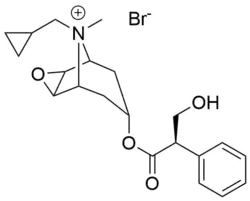 | |
| Clinical data | |
|---|---|
| ATC code | |
| Identifiers | |
IUPAC name
| |
| CAS Number | |
| PubChem CID | |
| UNII | |
| KEGG | |
| ChEMBL | |
| CompTox Dashboard (EPA) | |
| ECHA InfoCard | 100.169.259 |
| Chemical and physical data | |
| Formula | C21H28BrNO4 |
| Molar mass | 438.362 g·mol−1 |
  (what is this?) (verify) (what is this?) (verify) | |
Cimetropium bromide is a belladonna derivative. Evidence does not support its use in infantile colic.[1]
Person
| Feature | Value |
|---|---|
| Number of Hydrogen Acceptors | 4 |
| The number of hydrogen donors | 1 |
| Number of Rotational Connections | 7 |
| Partition coefficient[2] (-{ALogP)}- | -2,1 |
| Solubility[3] (-{logS, log(mol/L}-)) | -3,6 |
| Polar surface[4] (-{PSA}-, Å2) | 102,1 |
References
- ^ Hall B, Chesters J, Robinson A (February 2012). "Infantile colic: a systematic review of medical and conventional therapies". Journal of Paediatrics and Child Health. 48 (2): 128–37. doi:10.1111/j.1440-1754.2011.02061.x. PMID 21470331.
- ^ Prediction of Hydrophobic (Lipophilic) Properties of Small Organic Molecules Using Fragmental Methods: An Analysis of ALOGP and CLOGP Methods, doi:10.1021/jp980230o
- ^ Estimation of Aqueous Solubility of Chemical Compounds Using E-State Indices, doi:10.1021/ci000392t
- ^ Fast Calculation of Molecular Polar Surface Area as a Sum of Fragment-Based Contributions and Its Application to the Prediction of Drug Transport Properties, doi:10.1021/jm000942e