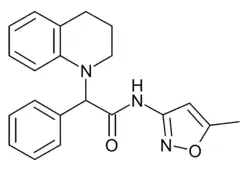
CIM-0216
Names
Preferred IUPAC name
2-(3,4-Dihydroquinolin-1(2H )-yl)-N -(5-methyl-1,2-oxazol-3-yl)-2-phenylacetamide
Identifiers
CAS Number
3D model (JSmol)
ChEMBL
ChemSpider
InChI=1S/C21H21N3O2/c1-15-14-19(23-26-15)22-21(25)20(17-9-3-2-4-10-17)24-13-7-11-16-8-5-6-12-18(16)24/h2-6,8-10,12,14,20H,7,11,13H2,1H3,(H,22,23,25)
Key: KSEXDSJYVSEVGF-UHFFFAOYSA-N
CC1=CC(=NO1)NC(=O)C(C2=CC=CC=C2)N3CCCC4=CC=CC=C43
Properties
Chemical formula
C 21 H 21 N 3 O 2
Molar mass
347.418 g·mol−1
Hazards
GHS labelling:
Pictograms
Signal word
Warning
Hazard statements
H302 , H315 , H319 , H335
Precautionary statements
P261 , P264 , P270 , P271 , P280 , P301+P312 , P302+P352 , P304+P340 , P305+P351+P338 , P312 , P321 , P330 , P332+P313 , P337+P313 , P362 , P403+P233 , P405 , P501
Except where otherwise noted, data are given for materials in their standard state (at 25 °C [77 °F], 100 kPa).
Infobox references
CIM-0216 is a chemical compound which acts as a potent and selective activator of the TRPM3 calcium channel. It produces nociception and inflammation and is used to study the function of the TRPM3 receptor in these processes.[ 1] [ 2] [ 3] [ 4]
References
^ Held K, Kichko T, De Clercq K, Klaassen H, Van Bree R, Vanherck JC, et al. (March 2015). "Activation of TRPM3 by a potent synthetic ligand reveals a role in peptide release" . Proceedings of the National Academy of Sciences of the United States of America . 112 (11): E1363-72. Bibcode:2015PNAS..112E1363H . doi:10.1073/pnas.1419845112 4371942 25733887 . ^ Thiel G, Rubil S, Lesch A, Guethlein LA, Rössler OG (October 2017). "Transient receptor potential TRPM3 channels: Pharmacology, signaling, and biological functions". Pharmacological Research . 124 : 92– 99. doi:10.1016/j.phrs.2017.07.014 . PMID 28720517 . ^ Kelemen B, Lisztes E, Vladár A, Hanyicska M, Almássy J, Oláh A, et al. (April 2020). "Volatile anaesthetics inhibit the thermosensitive nociceptor ion channel transient receptor potential melastatin 3 (TRPM3)" . Biochemical Pharmacology . 174 : 113826. doi:10.1016/j.bcp.2020.113826 2437/278831 31987857 . ^ Vangeel L, Benoit M, Miron Y, Miller PE, De Clercq K, Chaltin P, et al. (June 2020). "Functional expression and pharmacological modulation of TRPM3 in human sensory neurons" . British Journal of Pharmacology . 177 (12): 2683– 2695. doi:10.1111/bph.14994 . PMC 7236075 31985045 .
TRPA
Activators
4-Hydroxynonenal
4-Oxo-2-nonenal
5,6-EET
12S-HpETE
15-Deoxy-Δ12,14 -prostaglandin J2 α-Sanshool (ginger, Sichuan and melegueta peppers)Acrolein
Allicin (garlic)
Allyl isothiocyanate (mustard, radish, horseradish, wasabi)
AM404 ASP-7663 Bradykinin Cannabichromene (cannabis )
Cannabidiol (cannabis )Cannabigerol (cannabis )Cinnamaldehyde (cinnamon)
CR gas (dibenzoxazepine; DBO)
CS gas (2-chlorobenzal malononitrile)
Cuminaldehyde (cumin)
Curcumin (turmeric)
Dehydroligustilide (celery)
Diallyl disulfide
Dicentrine (Lindera spp.)
Farnesyl thiosalicylic acid
Formalin Gingerols (ginger)
Hepoxilin A3
Hepoxilin B3
Hydrogen peroxide
Icilin
Isothiocyanate JT-010 Ligustilide (celery, Angelica acutiloba )
Linalool (Sichuan pepper, thyme)
Methylglyoxal Methyl salicylate (wintergreen)N-Methylmaleimide
Nicotine (tobacco )Oleocanthal (olive oil)
Paclitaxel (Pacific yew)Paracetamol (acetaminophen) PF-4840154 Phenacyl chloride
Polygodial (Dorrigo pepper)
Shogaols (ginger, Sichuan and melegueta peppers)
Tear gases Tetrahydrocannabinol (cannabis )Tetrahydrocannabiorcol Thiopropanal S-oxide (onion)
Umbellulone (Umbellularia californica )
WIN 55,212-2 Blockers
TRPC
TRPM
Activators
ADP-ribose
BCTC
Calcium (intracellular)Cold
Coolact P
Cooling Agent 10
Eucalyptol (eucalyptus)Frescolat MGA
Frescolat ML
Geraniol
Hydroxycitronellal
Icilin
Linalool
Menthol (mint)PMD 38
Pregnenolone sulfate Rutamarin (Ruta graveolens )
Steviol glycosides (e.g., stevioside) (Stevia rebaudiana )
Sweet tastants (e.g., glucose , fructose, sucrose; indirectly)
Thio-BCTC
WS-12 Blockers
TRPML
TRPP
TRPV
Activators
2-APB
5,6-EET
9-HODE
9-oxoODE
12S-HETE
12S-HpETE
13-HODE
13-oxoODE
20-HETE α-Sanshool (ginger, Sichuan and melegueta peppers)Allicin (garlic)
AM404 Anandamide Bisandrographolide (Andrographis paniculata )
Camphor (camphor laurel, rosemary, camphorweed, African blue basil, camphor basil)
Cannabidiol (cannabis )Cannabidivarin (cannabis )Capsaicin (chili pepper)Carvacrol (oregano, thyme, pepperwort, wild bergamot, others)
DHEA Diacyl glycerol
Dihydrocapsaicin (chili pepper)
Estradiol Eugenol (basil, clove)
Evodiamine (Euodia ruticarpa )Gingerols (ginger)
GSK1016790A Heat
Hepoxilin A3
Hepoxilin B3
Homocapsaicin (chili pepper)
Homodihydrocapsaicin (chili pepper)
Incensole (incense)
Lysophosphatidic acid
Low pH (acidic conditions)
Menthol (mint)N-Arachidonoyl dopamine
N-Oleoyldopamine
N-Oleoylethanolamide Nonivamide (PAVA) (PAVA spray)
Nordihydrocapsaicin (chili pepper)
Paclitaxel (Pacific yew)Paracetamol (acetaminophen) Phenylacetylrinvanil Phorbol esters (e.g., 4α-PDD)
Piperine (black pepper, long pepper)Polygodial (Dorrigo pepper)
Probenecid Protons
RhTx
Rutamarin (Ruta graveolens )
Resiniferatoxin (RTX) (Euphorbia resinifera/pooissonii )
Shogaols (ginger, Sichuan and melegueta peppers)
Tetrahydrocannabivarin (cannabis )Thymol (thyme, oregano)Tinyatoxin (Euphorbia resinifera/pooissonii )
Tramadol Vanillin (vanilla)
Zucapsaicin Blockers
See also: Receptor/signaling modulators • Ion channel modulators